
Back to home

Allergen Risk Assessment: A Guide for UK Kitchens

An allergen risk assessment is how you work out where allergens are in your kitchen, how they could end up in the wrong dish, and what you do to stop it. It sits inside your wider food safety risk assessment, where allergens are one of the four types of hazard.

This guide covers what the law expects, how cross-contact happens, the controls the FSA recommends, and when you should tell a customer you cannot make a dish safe for them. It is written for cafés, restaurants, takeaways and caterers in the UK.

What the law expects

GOV.UK's allergen guidance says food businesses must:

  • give allergen information to customers for both prepacked and non-prepacked food and drink
  • handle and manage food allergens effectively in food preparation
  • train staff on allergens

The FSA's Safer Food, Better Business pack says it is a legal requirement to give accurate information about the allergenic ingredients in the food you serve. Your local council enforces these rules. GOV.UK says a business that breaks them can be given an improvement notice, and failing to follow that notice can lead to a penalty.

The 14 allergens

These are the allergens you must declare when they are in your food:

  • celery
  • cereals containing gluten, such as wheat, rye, barley and oats
  • crustaceans
  • eggs
  • fish
  • lupin
  • milk
  • molluscs
  • mustard
  • peanuts
  • sesame
  • soybeans
  • sulphur dioxide and sulphites, above 10 parts per million
  • tree nuts

Step 1: Know what is in every dish

You cannot assess a risk you have not found. GOV.UK says to record the allergenic ingredients in writing, and keep that record:

  • on product specification sheets from your suppliers
  • on ingredient labels, with ingredients kept in their original or labelled containers
  • in your recipes, thinking about what a recipe change does to the allergens
  • up to date

Check deliveries too. SFBB says to check you received the correct order and labelling information, because a different product may contain different allergens. If a supplier swaps a product, check its allergen information before you use it.
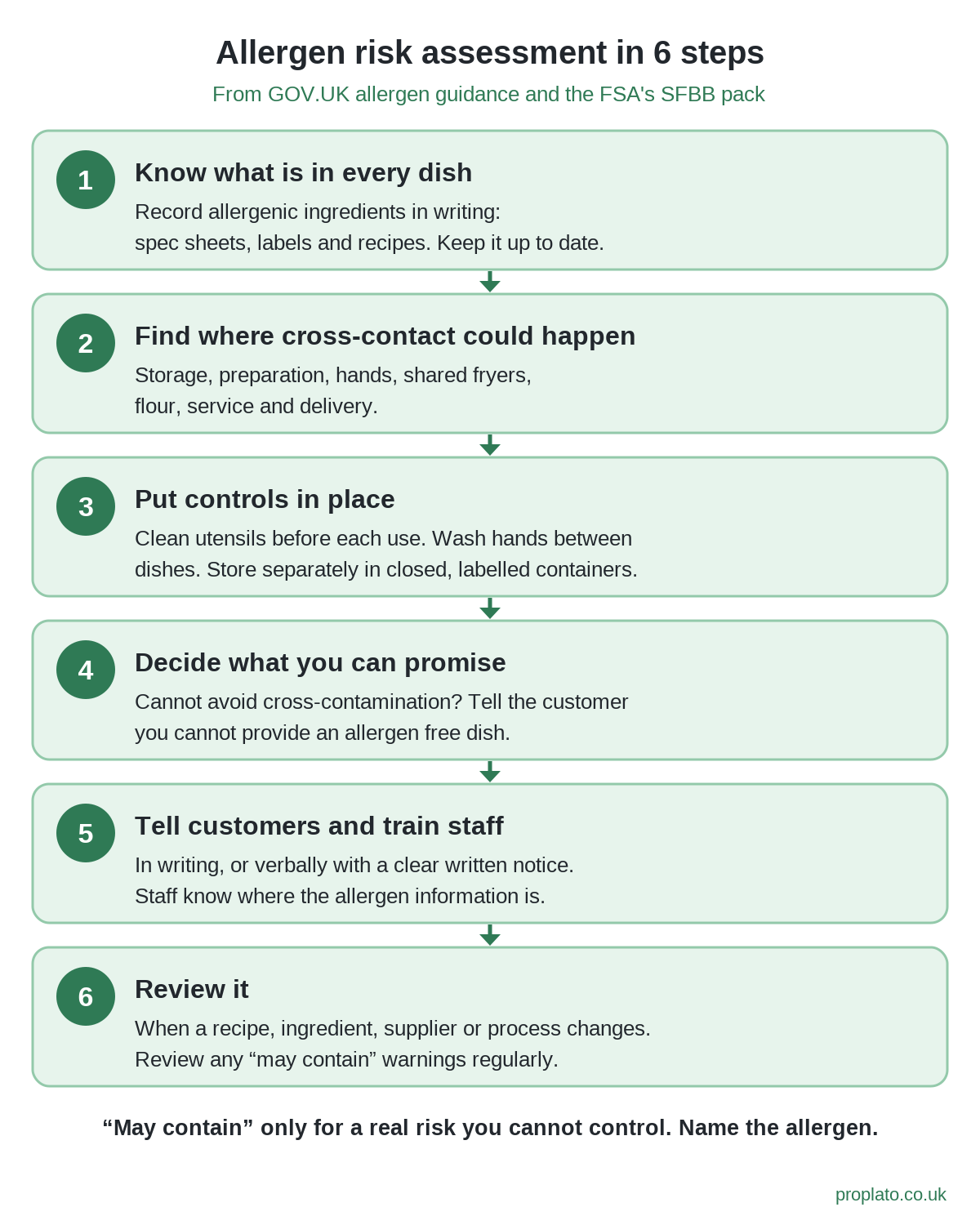
Allergen risk assessment in 6 steps, from GOV.UK allergen guidance and the FSA's SFBB pack. 1, know what is in every dish: record allergenic ingredients in writing on spec sheets, labels and recipes, and keep it up to date. 2, find where cross-contact could happen: storage, preparation, hands, shared fryers, flour, service and delivery. 3, put controls in place: clean utensils before each use, wash hands between dishes, store separately in closed, labelled containers. 4, decide what you can promise: if you cannot avoid cross-contamination, tell the customer you cannot provide an allergen free dish. 5, tell customers and train staff: in writing, or verbally with a clear written notice, and staff know where the allergen information is. 6, review it when a recipe, ingredient, supplier or process changes, and review any may contain warnings regularly. Use may contain only for a real risk you cannot control, and name the allergen.

Step 2: Find where cross-contact could happen

Cross-contact is when an allergen gets into a dish that should not contain it. Walk through your kitchen from delivery to service and look at each step:

  • Storage: are allergen ingredients kept open, or next to other foods?
  • Preparation: do the same boards, bowls and utensils go from one dish to the next?
  • Hands: do staff wash their hands between dishes with and without an allergen?
  • Cooking: is a fryer or pan shared? GOV.UK's example: you cannot use oil that has already been used to cook battered fish to make gluten free chips.
  • Flour and dust: if you handle wheat flour, can it reach other food?
  • Service and delivery: can the right information reach the customer with the dish?

For each risk, ask the same two questions as any food safety risk assessment: how likely is it, and how serious would it be? MyHACCP lists food allergens among the most severe hazards.

Step 3: Put controls in place

GOV.UK lists these ways to avoid cross-contamination with allergens:

  • clean utensils before each use, especially if they were used for meals containing allergens
  • wash hands thoroughly between preparing dishes with and without certain allergens
  • store ingredients and prepared foods separately, in closed and labelled containers
  • keep ingredients that contain allergens separate from other ingredients

If you handle wheat flour and cannot remove the risk through separating by time and space, GOV.UK says to tell the customer and not make gluten free or wheat free claims.

Step 4: Decide what you can promise

Sometimes the honest answer is no. GOV.UK says that if you cannot avoid cross-contamination, you should tell customers you cannot provide an allergen free dish.

Be careful with claims:

  • Free from: GOV.UK says free from claims need strict controls on ingredients, how they are handled and how they are prepared.
  • Vegan: customers sometimes assume vegan meals are free from allergens that come from animals. Low level cross-contamination can still happen, so be clear about that risk.
  • "May contain": GOV.UK says to use a precautionary allergen warning only when you have found a cross-contamination risk you cannot control. It should name the allergen, such as "may contain milk". Do not use general wording such as "may contain allergens", and do not put "may contain" next to a free from claim for the same allergen. A warning is never a substitute for good hygiene.

Our allergen labelling guide explains the labelling rules for prepacked, prepacked for direct sale and loose food.

Step 5: Tell customers and train staff

For loose food, you can give allergen information in writing on a menu, chalkboard or information pack, or verbally with a clear written notice telling customers to ask. GOV.UK says written information supported by a conversation works best.

For delivery and takeaway orders, the customer needs allergen information before they buy and again when the food arrives.

Staff must be trained on allergens. They should know where the allergen information is kept and how to handle a customer's request. The FSA offers free online allergen training.

Step 6: Review it

Review your allergen assessment whenever something changes. SFBB says to update your list of allergen ingredients when your menu changes. GOV.UK says to review any "may contain" warnings regularly, especially when suppliers or processes change. Our food safety audit guide shows how to build this into your regular checks.

Pro Plato's free plan includes an allergen matrix with a customer QR code and PDF and Excel export, so your allergen information is in one place and easy to update when a recipe changes.

Frequently asked questions

Is an allergen risk assessment a legal requirement?

The law requires you to manage allergens effectively and give customers accurate allergen information. Your food safety system must also follow the HACCP principles, and MyHACCP lists allergens as one of the four types of hazard to look for. A written allergen assessment is a practical way to show you have done this.

Can I just put "may contain" on everything?

No. GOV.UK says a warning should only be used when you have found a real risk you cannot control. Using it with no genuine risk could mislead customers and break food law.

What if a customer with an allergy asks for a dish I cannot make safely?

Tell them. GOV.UK says that if you cannot avoid cross-contamination, you should tell customers you cannot provide an allergen free dish.

How often should I review it?

Whenever a recipe, ingredient, supplier or process changes, and as part of your regular food safety reviews.

Sources

Checked 19 November 2026.

Note: this is general guidance for UK food businesses, not legal advice. Rules differ slightly across England, Wales, Scotland and Northern Ireland, so follow your local authority's advice. Last checked 21 November 2026.

Stay inspection-ready, every day

Daily temperature and checklist logs, a live allergen matrix and inspection packs. Start free, and add exports when you need them.

More guides

EHO Visit Checklist for UK Food BusinessesWhat an environmental health officer checks on the day, and the records you need ready.Digital SFBB vs Paper Pack for UK CaterersHonest pros and cons of digital vs paper food safety packs, and when paper still makes sense.HACCP & Allergen Compliance for Small UK CaterersPractical HACCP and allergen controls for small catering businesses, without the jargon.Food Safety in Hot WeatherTemperature limits, cool box rules and summer routines for event caterers.Event Day Checklist for Street Food TradersFrom loading the van to post-event admin, a repeatable routine for every event.Commercial Kitchen Layout, Waste and Gas SafetyDesign a kitchen that is easy to keep clean, and know your waste and gas duties.Documents You Need to Trade at Markets and Food FestivalsWhat organisers ask for, which items are the law, and how to keep them in date.On-Site Checks for Event OrganisersA practical food, fire and gas checklist for organisers admitting caterers.Free COSHH Assessment Template for KitchensA one-page COSHH assessment for kitchen chemicals, with a worked example.Free Allergen Matrix TemplateA printable 14-allergen matrix for your menu, with a worked example.Free HACCP Plan TemplateA HACCP plan template that walks through the seven principles in order.Pro Plato vs Paddl (2026): Prices, Features and Which Suits Your KitchenPro Plato and Paddl side by side: price for 1 to 3 sites, free plan, HACCP and AI tools.Pro Plato vs Forkto (2026): Prices, Plans and Which Suits Your KitchenPro Plato and Forkto side by side: price for real kitchens, free plan, HACCP and sensors.How to Choose Food Safety Software: 10 Questions to AskTen questions to ask any food safety app supplier before you pay, from UK rules and HACCP to pricing, contracts, allergens, records and offline use, plus a one week test plan.What Is HACCP Software? A Plain Guide for UK Food BusinessesA plain guide to HACCP software for UK food businesses: what it does against the seven HACCP principles, plan builders vs check loggers, when a full HACCP plan is needed, when the FSA's SFBB pack is enough, and the free FSA routes (SFBB, templates, MyHACCP).Cheapest HACCP Software in the UK (2026): What a HACCP Plan Really CostsWhat a HACCP based system costs a UK food business: the free FSA MyHACCP tool, SFBB and CookSafe packs, plan builders (NCASS, Pro Plato, Hubl, FoodDocs) and check-only apps (TempTake, Lemon), with prices from each supplier's own site and hidden costs to check.Best Food Safety Software for UK Kitchens in 2026A fair shortlist of food safety apps for UK kitchens: Pro Plato, TempTake, Hubl, Lemon, Trail, CompliChef, NCASS, FoodDocs and the free SFBB pack, with prices, free plans, HACCP tools and who each suits.Food Safety Risk Assessment: A Guide for UK KitchensHow a UK food business does a food safety risk assessment (hazard analysis): the legal duty, hazard vs risk, the four hazard types, how hazards arise, MyHACCP severity and likelihood scoring, controls, records and review.Food Safety Audit: How to Check Your Own KitchenHow a UK food business audits its own kitchen: the Article 5 duty to verify and review, validation vs verification vs review, the SFBB 4 weekly review checklist, prove it checks, annual reviews and what to record.How to Appeal a Food Hygiene Rating in the UKThe three FHRS safeguards side by side: appeal within 21 days, right to reply, and re-rating inspections, with the rules for England, Wales, Northern Ireland and Scotland.How Quickly Should You Cool Food? UK Rules for Food BusinessesWhat UK law and official guidance say about cooling cooked food: no fixed minutes in law, the 2 hour rule for hot food, 8°C and 5°C, SFBB cooling methods, freezing, reheating once and what to record.Allergen QR Code for Your Menu: How to Set It UpA QR code customers scan to check the 14 allergens in every dish. It updates itself when a recipe changes, and customers can look but never edit.Staff Rota for UK Restaurants, Cafés and CaterersThe UK rules that shape a kitchen rota (breaks, daily and weekly rest, the 48-hour week, young workers) and the hours records to keep.Fridge and Freezer Temperatures for UK Food BusinessesThe 5°C rule, freezer temps, daily checks and what to write down.Hot Holding Temperature: The 63°C Rule for UK Food BusinessesThe 63°C rule, the 2-hour exception, what to do if food drops below 63°C and what to write down.Food Safety Management Systems: A Guide for UK Small Food BusinessesWhat the law asks for, the 7 HACCP principles in plain English, and which free template fits your business.Cross-Contamination in Food Businesses: A UK Guide to PreventionWhat cross-contamination is, the FSA controls for raw and ready-to-eat food, cleaning, cloths, allergens and what to do if it happens.Opening a Takeaway in the UK: The Food Safety ChecklistRegistration, a food safety system, temperatures, training, allergens for delivery orders, supplier records and late night licences.The 4 Cs of Food Safety: A Guide for UK Food BusinessesCleaning, cooking, chilling and cross-contamination in plain English: the FSA's four main areas, the key temperatures, and the records behind each one.Opening and Closing Checklist for UK Food BusinessesThe FSA's daily opening and closing checks in plain English: what to check, why it matters, extra weekly checks and how to record them in the SFBB diary.Food Safety Compliance for UK Food BusinessesA plain English checklist of the legal duties that come with running a UK food business, with links to the detailed guides.Food Safety Temperatures for UK Food BusinessesEvery key temperature on one page: fridges, freezers, defrosting, cooking, reheating, hot holding and probe checks, with what to record.Allergen Labelling for UK Food BusinessesThe allergen rules for each way food is sold: prepacked, prepacked for direct sale (Natasha's Law), loose food and delivery, plus may contain labels and records.Hygiene Emergency Prohibition Notices: A Guide for UK Food BusinessesWhen a council officer can close a process, equipment or premises straight away, the three day court deadline, getting the ban lifted, compensation and the rules in each UK nation.

Food safety compliance software for UK restaurants, caterers and food traders: daily records, allergens, HACCP, COSHH and inspection-ready packs.

General information for food businesses in England, not legal advice. Your local authority food team can advise on your business. Pro Plato is not affiliated with or endorsed by the Food Standards Agency.

© 2026 Pro Plato is a trading name of Pakotaco Ltd, registered in England and Wales, company no. 15078610. Registered office: 125 Poynton Road, London, N17 9SJ, United Kingdom.