
Opening and Closing Checklist for UK Food Businesses
Opening and closing checks are the short list of things you check every day when you start and finish service. They take a few minutes, but they are the backbone of your food safety records. The Food Standards Agency (FSA) says it is essential that you and your staff do these checks every time you open and close.
This guide sets out the checks from the FSA's Safer Food, Better Business (SFBB) pack in plain English, explains why each one matters, and shows how to record them. It is written for cafés, restaurants, takeaways, pubs and caterers.
Why opening and closing checks matter
GOV.UK says every food business needs a food safety management system: a written set of processes, checks, rules and records. Opening and closing checks are the part you do every single day. The FSA says they help you keep the basic standards you need to make sure your business makes food safely.
In SFBB, the manager signs the diary every day to say the opening and closing checks have been done and the safe methods have been followed. The FSA says the diary should take about one minute a day, unless something unusual needs writing down.
If you are not sure how SFBB fits into the bigger picture, our guide to food safety management systems explains it.
Opening checklist
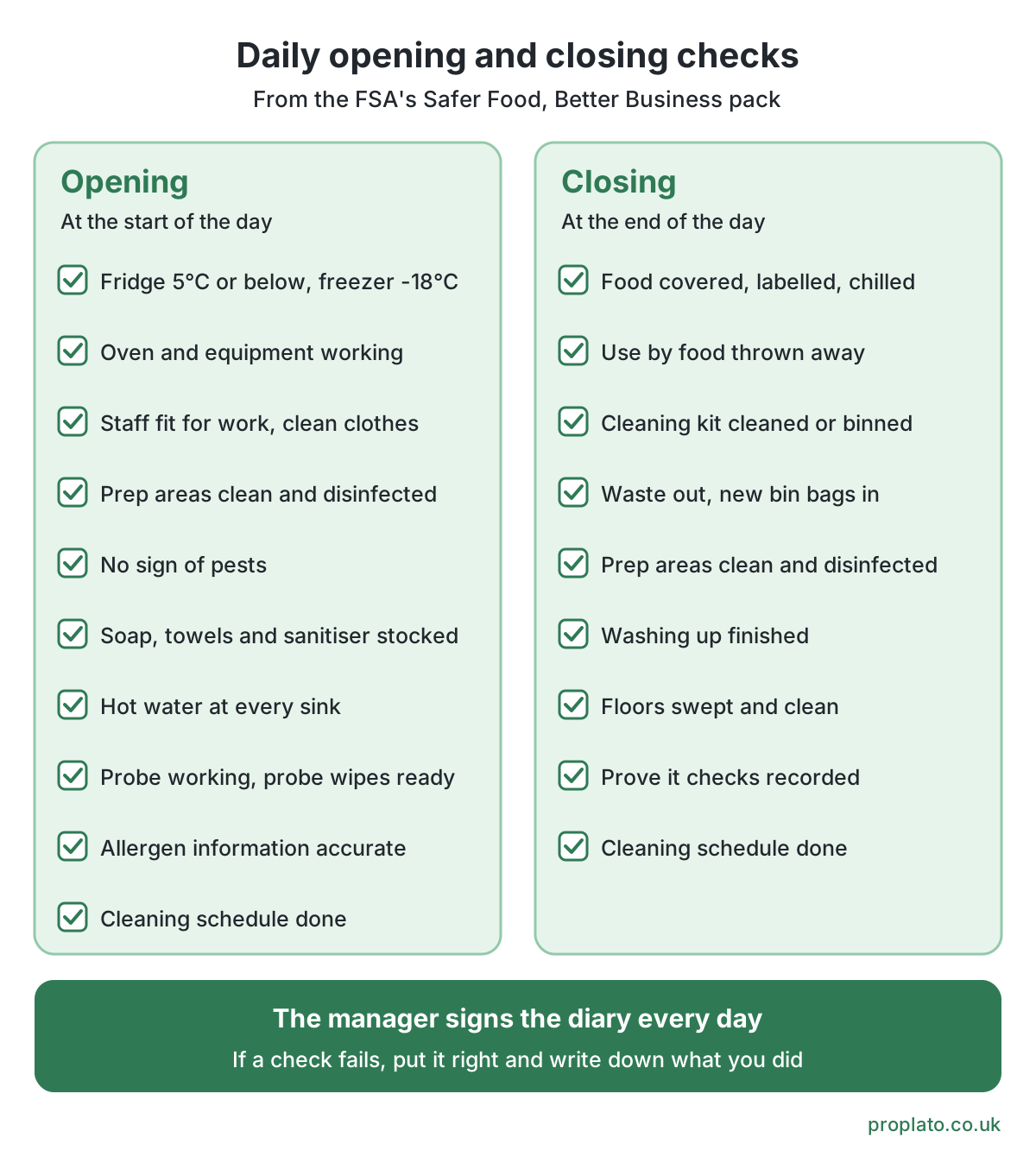
The FSA says to do these checks at the beginning of the day. You can add your own checks to the list.
- Fridges, chilled display equipment and freezers are working properly. GOV.UK says to set your fridge to 5°C or below, so food stays cold enough even if the temperature changes. Frozen food should be kept at -18°C or below.
- Other equipment, such as the oven, is working properly.
- Staff are fit for work and wearing clean work clothes.
- Food preparation areas are clean and disinfected. This means work surfaces, equipment and utensils.
- All areas are free from evidence of pest activity.
- There are plenty of handwashing and cleaning materials. Soap, paper towels and sanitiser.
- Hot running water is available at all sinks and hand wash basins.
- The probe thermometer is working and probe wipes are available.
- Allergen information is accurate for all items on sale.
- Cleaning has been done according to the cleaning schedule.
What to look for
A fridge that is "working" is one that is holding the right temperature, not just one that is switched on. Read the display or use a thermometer and write the reading down. Our guide to fridge and freezer temperatures explains what to do if a reading is too high.
The allergen check is easy to miss. If a supplier has changed an ingredient, or a dish has changed, update your allergen information before you serve it.
Closing checklist
The FSA says to do these checks at the end of the day. Again, you can add your own.
- All food is covered, labelled and put in the fridge or freezer where appropriate.
- Food on its use by date has been thrown away.
- Dirty cleaning equipment has been cleaned or thrown away.
- Waste has been removed and new bags put in the bins.
- Food preparation areas are clean and disinfected.
- All washing up has been finished.
- Floors are swept and clean.
- "Prove it" checks have been recorded. These are the temperature checks that show your methods work.
- Cleaning has been done according to the cleaning schedule.
What to look for
Labelling matters because food with a use by date, cooked dishes and other ready to eat food have a limited shelf life. SFBB says food cannot be supplied or served after its use by date. It also says high risk ready to eat food should be kept for a maximum of 3 days in total (the day it was cooked or opened, plus 2), unless you have evidence it is safe for longer.
Covering food and storing it properly also cuts the risk of cross-contamination overnight. Our cross-contamination guide covers fridge storage order.
Extra checks
Some checks do not need doing every day. SFBB calls these "extra checks" and gives examples:
| Extra check | What it involves | |---|---| | Deep clean | Behind equipment, vents, walls, ceilings and outside waste areas | | Maintenance | Clear drains and fridge or freezer condensers; follow up repairs | | Dishwasher | Remove food debris and limescale from jets, filters and drains | | Temperature probe | Check it reads within 1°C of 100°C in boiling water and 0°C in melting ice | | Pest control | Look for damage to walls and doors and for signs of pests |
You decide how often to do each one and write it down. In the SFBB diary there is a box at the end of each week for the extra checks you have done.
How to record your checks
GOV.UK says you must be able to prove that you are cleaning effectively, and the same idea runs through every check. A check that is not written down is hard to prove.
With SFBB, the daily diary page has a space for opening checks and closing checks, a name and a signature. There is also a line for "any problems or changes: what did you do?". The FSA says that if something goes wrong, you should note what happened and what you did. This shows you took action to make sure food was safe to eat.
Every 4 weeks, SFBB asks you to do a review. Look back over the diary, spot any problems that keep coming back, and decide how to fix them. That might mean retraining staff or changing how you do things.
If you use another pack, such as CookSafe in Scotland or Safe Catering in Northern Ireland, follow the records your own pack asks for.
Common mistakes
- Ticking without checking. A signature on a check that was not done is worse than a blank.
- No action written down. If a fridge reads too warm, write what you did about it.
- Checks only one person knows. If the manager is not in, SFBB says they can give responsibility for the diary to another member of staff. Make sure that person knows the checks.
- A list that never changes. Add checks that fit your kitchen, such as a hot holding unit or a delivery check.
The records are what an environmental health officer will ask to see. Our EHO visit checklist shows what else to have ready.
Doing the checks on a phone
Paper diaries work, but they are easy to forget and hard to search. Pro Plato is one digital option. The Free plan includes opening and closing checklists and basic temperature checks on your phone. The Pro plan (£19 a month) adds photo uploads with timestamps, alerts and reminders, and a print ready audit export.
Frequently asked questions
Are opening and closing checks a legal requirement?
The law requires a food safety management system based on HACCP principles, with records that suit the size of your business. Opening and closing checks are how SFBB, the FSA's free pack, puts that into daily practice.
Who should sign the opening and closing checks?
In SFBB, the manager signs the diary every day. If the manager is not in, they can give that responsibility to another member of staff.
How long do opening and closing checks take?
The FSA says the SFBB diary should take about one minute a day to complete, unless you need to write down something unusual. The checks themselves take a few minutes more.
Can I add my own checks?
Yes. The FSA says you can add your own checks to both the opening and the closing lists.
What happens if a check fails?
Put it right, then write down what happened and what you did in the diary. Look for patterns at your 4-weekly review.
Sources
Checked 9 November 2026.
- FSA: SFBB for caterers, opening and closing checks (PDF)
- FSA: SFBB diary introduction (PDF)
- FSA: SFBB diary and 4-weekly review (PDF)
- FSA: SFBB, prove it (PDF)
- FSA: SFBB, chilled storage and display (PDF)
- FSA: Safer food, better business for caterers
- GOV.UK: Food hygiene for your business, chilling and freezing
- GOV.UK: Food hygiene for your business, cleaning
- GOV.UK: Food safety management systems
- legislation.gov.uk: Regulation (EC) No 852/2004, Article 5
Note: this is general guidance for UK food businesses, not legal advice. Rules differ slightly across England, Wales, Scotland and Northern Ireland, so follow your local authority's advice. Last checked 9 November 2026.