Allergen Labelling for UK Food Businesses
Every food business in the UK must tell customers when food contains any of the 14 allergens. How you do it depends on how the food is sold: prepacked, prepacked for direct sale, loose, or ordered online for delivery.
This guide explains each type in plain English, including Natasha's Law, so you can check what your café, restaurant, takeaway or catering business needs to do.
The 14 allergens
Food law lists 14 allergens that must be declared when they are used as an ingredient:
- celery
- cereals containing gluten (such as wheat, rye, barley and oats)
- crustaceans (such as prawns, crabs and lobsters)
- eggs
- fish
- lupin
- milk
- molluscs (such as mussels and oysters)
- mustard
- peanuts
- sesame
- soybeans
- sulphur dioxide and sulphites (above ten parts per million)
- tree nuts (such as almonds, hazelnuts, walnuts, brazil nuts, cashews, pecans, pistachios and macadamia nuts)
This also covers additives, processing aids and any other substance from these allergens that ends up in the final food. Customers may react to other ingredients too, but only these 14 must be declared by law.
Which type of food are you selling?
The rules change with the way the food reaches the customer. The FSA uses three main types.
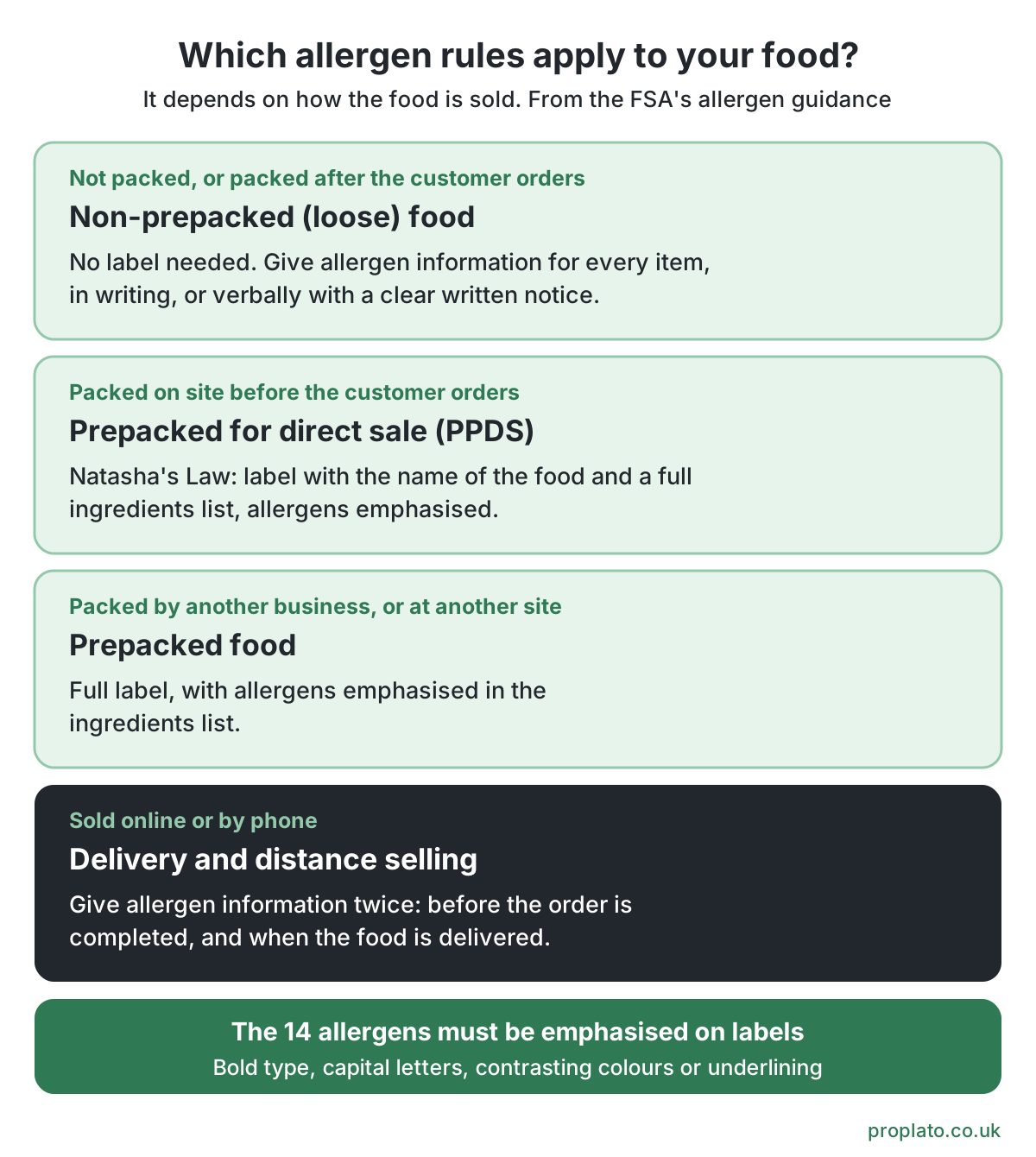
| Type | What it means | What you must do | |---|---|---| | Prepacked | Packed by another business, or at another site, before it is offered for sale | Full label, with allergens emphasised in the ingredients list | | Prepacked for direct sale (PPDS) | Packed on the same premises where it is sold, before the customer orders it | Label with the name of the food and a full ingredients list, allergens emphasised | | Non-prepacked (loose) | Not packed, or packed after the customer orders it | Allergen information for every item, in writing or verbally |
The FSA has an allergen and ingredients labelling tool that walks you through the questions if you are not sure which type you sell.
Prepacked for direct sale and Natasha's Law
Since 1 October 2021, PPDS food must carry a label. The change is known as Natasha's Law. It applies in England, Wales and Northern Ireland, and Scotland has the same requirement with its own guidance from Food Standards Scotland.
Food is PPDS when it is packed on site before the customer chooses it. FSA examples for restaurants, cafés and pubs include:
- prepacked sandwiches or salad boxes
- prepacked paninis or boxes of pizza that can be reheated on request
- pies in packaging
- soup already in pots
The FSA says food counts as packaged when it is fully or partly enclosed, cannot be altered without opening the packaging, and is ready for sale. A cake in cling film or sandwiches in a folded paper bag count. A burger on an open cardboard tray does not.
Hot drinks made to order are not PPDS. If you pour and lid drinks before customers order, ahead of a rush, those drinks are PPDS and need a label.
What goes on a PPDS label
The label must show:
- the name of the food
- an ingredients list, headed with a word that includes "ingredients"
- any of the 14 allergens emphasised every time they appear in that list
You can emphasise allergens with bold type, capital letters, contrasting colours or underlining. Ingredients go in descending order of weight. Compound ingredients, such as the bread in a sandwich, need their own ingredients listed after them.
Labels can be handwritten if they meet the legal font size rules and are clearly legible. The customer should not need to open the packaging to read the label.
Non-prepacked (loose) food
Meals served in a restaurant, food from a takeaway counter and unpackaged cakes on display are non-prepacked. They do not need a label, but you must give allergen information for every item that contains any of the 14 allergens.
You can do this by:
- writing full allergen information on a menu, chalkboard or in an information pack
- telling customers verbally, with a clearly visible written notice that explains how to get the information
The FSA's advice is that written allergen information, supported by a conversation, works best for customers. Our free allergen matrix template is one way to keep that written record for every dish.
For a buffet, give allergen information for each dish separately, not for the buffet as a whole.
Delivery and online orders
Food sold online or by phone is distance selling. PPDS labelling does not apply to it, but allergen information must be given at two stages:
- before the order is completed, in writing (website or menu) or verbally (by phone)
- when the food is delivered, in writing (allergen stickers or an enclosed menu) or verbally
The FSA advises giving written allergen information at both stages. Takeaway meals should be labelled clearly so customers know which dishes suit them. Our guide to opening a takeaway covers this in more detail.
"May contain" labels
Precautionary allergen labels such as "may contain" are not a legal requirement. The FSA recommends using them for PPDS food only when a real risk of cross-contact has been found through a risk assessment and cannot be removed by segregation or cleaning.
If a supplier's ingredient carries a "may contain" warning, pass that on to the customer. Using "may contain" where there is no real risk can mislead customers and limits their choice.
Free from, gluten free and vegan
A free from claim is a guarantee that the food is suitable for everyone with that allergy. If you handle wheat flour and cannot remove the risk of cross-contamination, the FSA says you should not make gluten free or wheat free claims.
Vegan is not the same as allergen free. Traces of milk, egg, fish, crustaceans or molluscs can still get in during preparation, so be clear with customers about that risk.
Keeping allergen records
Labels and menus are only right if your records are right. The FSA says allergen ingredient information should be:
- recorded on product specification sheets
- kept on ingredient labels, with ingredients stored in original or labelled containers
- included in recipes, and checked again when a recipe or supplier changes
- kept up to date
Staff must be trained on allergens. The FSA offers free online food allergy training.
What happens if you get it wrong
Local authorities enforce the allergen rules. If you do not act on their advice, they can issue an improvement notice. If you do not meet it, you face a penalty, and some businesses are prosecuted. You have 14 days from the date of an improvement notice to appeal it.
Keeping your allergen matrix up to date
Every Pro Plato plan, including Free, includes a live allergen matrix that links your menu to the 14 allergens, so the matrix changes when a dish changes. Customers can check it themselves by scanning a customer allergen QR code, and you can export it as a PDF or Excel file.
Frequently asked questions
Do I need to label food I make to order?
No. Food made to order, or packed at the customer's request, is non-prepacked. You still must give allergen information, in writing or verbally.
Does Natasha's Law apply to sandwiches made that morning?
Yes, if they are packed on site before the customer chooses them. They need a label with the name, full ingredients and allergens emphasised.
Can I tell customers about allergens verbally?
For non-prepacked food, yes, with a clearly visible written notice explaining how to ask. The FSA advises written information as well. PPDS food needs a label.
How should allergens appear on a label?
Emphasised every time they appear in the ingredients list, using bold type, capital letters, contrasting colours or underlining.
Do I need allergen information for delivery orders?
Yes, both before the order is completed and when the food is delivered.
Sources
Checked 12 November 2026.
- FSA: Allergen guidance for food businesses
- FSA: Introduction to allergen labelling for PPDS food
- FSA: PPDS allergen labelling changes for restaurants, cafés and pubs
- FSA: Labelling guidance for PPDS food products
- FSA: Food allergen labelling and information requirements technical guidance
- GOV.UK: Food labelling and packaging
- Food Standards Scotland: Allergen labelling
Note: this is general guidance for UK food businesses, not legal advice. Rules differ slightly across England, Wales, Scotland and Northern Ireland, so follow your local authority's advice. Last checked 13 November 2026.