
Food Safety Management Systems: A Guide for UK Small Food Businesses
Every food business in the UK needs a food safety management system. That sounds like a big piece of paperwork, but for most small businesses it is a set of written methods, daily checks and records. This guide explains what the law asks for, which free templates fit your business, and how to keep the system working day to day.
What is a food safety management system?
GOV.UK describes it as "a written set of processes, checks, rules and records". In practice it usually covers:
- cleaning and hygiene rules
- safe cooking and storage methods
- allergen controls
- staff training
- temperature checks
GOV.UK says that if you run a food business, you need one to make sure your food is safe to eat.
What the law requires
The legal requirement comes from Article 5 of Regulation (EC) No 852/2004, which still applies in the UK. Food business operators must put in place, run and maintain a permanent procedure based on the HACCP principles. HACCP stands for Hazard Analysis and Critical Control Point.
The law is flexible about size. Your documents and records must be "commensurate with the nature and size of the food business". A small café does not need the same paperwork as a factory.
The 7 HACCP principles in plain English
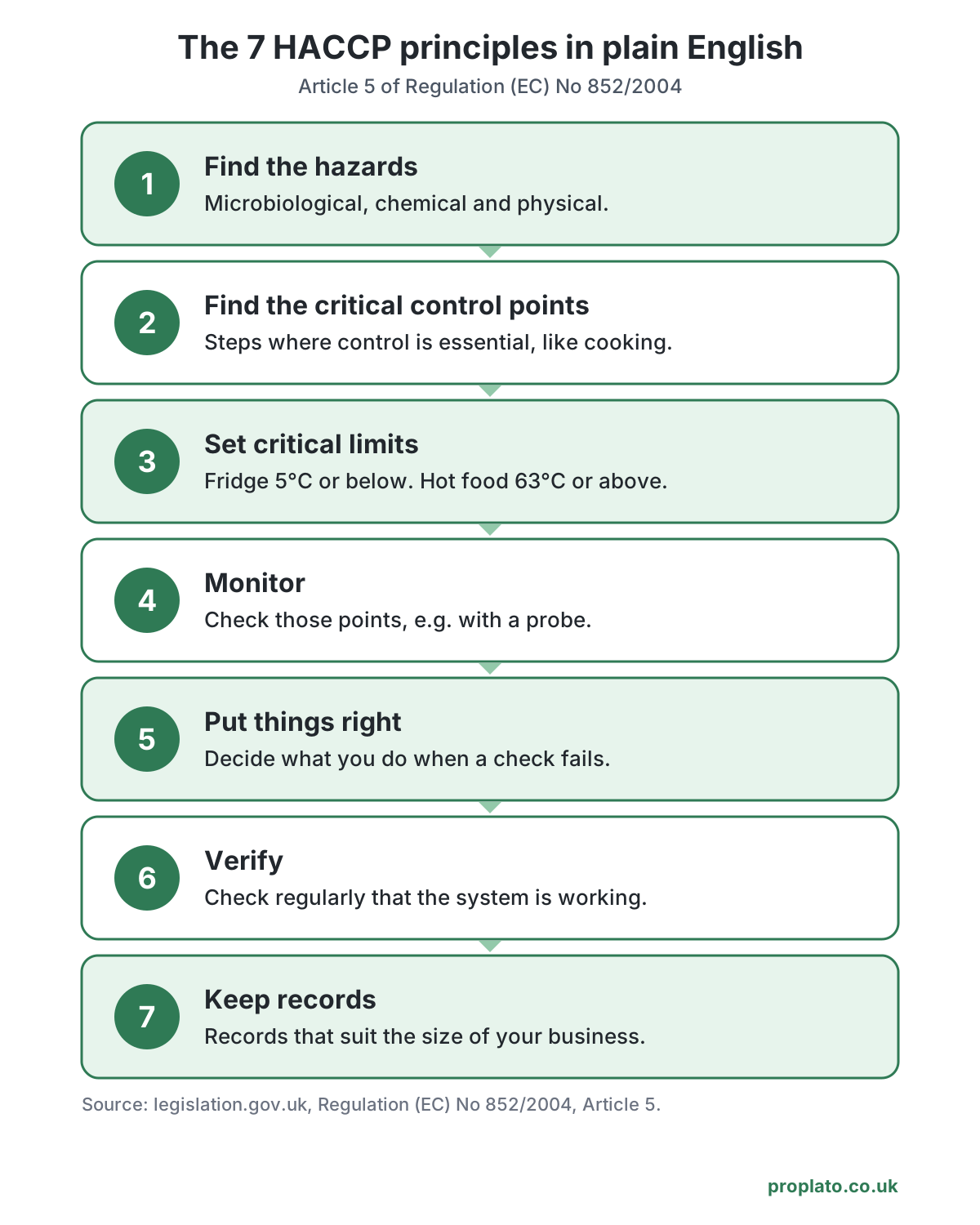
Article 5 lists seven principles. In simple terms:
- Find the hazards. What could make your food unsafe? GOV.UK groups hazards as microbiological, chemical and physical.
- Find the critical control points. These are the steps where control is essential, such as cooking or chilling.
- Set critical limits. For example, a fridge at 5°C or below, or hot food held at 63°C or above.
- Monitor. Check those points, for example with a probe thermometer.
- Put things right. Decide what you will do when a check fails.
- Verify. Check regularly that the system is working.
- Keep records. Keep documents and records that suit the size of your business.
Which system should you use?
You do not have to write everything from scratch. The FSA and Food Standards Scotland publish free templates. Which one fits depends on where you trade and what you do.
England and Wales: Safer Food, Better Business
GOV.UK says the FSA's Safer Food, Better Business (SFBB) toolkits are designed for small catering businesses such as restaurants, cafés and takeaways. There are versions for retailers, Indian and Chinese cuisine, childminders and care homes. SFBB includes a diary for daily records.
Northern Ireland: Safe Catering
GOV.UK says businesses in Northern Ireland should use the Safe Catering guidance instead of SFBB.
Scotland: CookSafe
Food Standards Scotland's CookSafe helps catering businesses in Scotland understand and put in place HACCP-based systems.
Manufacturers and higher-risk businesses: MyHACCP
MyHACCP is a free FSA web tool that guides you through building a HACCP-based system. The FSA says it is aimed at small food manufacturing businesses in the UK. For simple processes, like most restaurants, cafés and sandwich bars, the FSA says SFBB or Safe Catering is likely to be a simpler fit.
GOV.UK adds that larger or higher-risk businesses may need a more detailed HACCP plan, as advised by the local food safety team. Our HACCP plan template guide explains what goes into one.
How to set one up
GOV.UK suggests three steps:
- Contact your local food safety team at your council. They can advise which approach suits you.
- Build your system using guidance and templates.
- Check, review and update it regularly, and whenever you change your food processes or suppliers.
If you are starting a new business, you also need to register with your local authority. In England, Wales and Northern Ireland, GOV.UK says to register at least 28 days before you start trading.
Keeping it working
A system on a shelf does not keep food safe. The checks have to happen every day.
- Keep daily records. SFBB says the pack must outline your food safety practices, with daily records kept in the diary.
- Record problems and fixes. Write down what went wrong and what you did about it.
- Review it when things change. The law says that when you change a product, process or step, you must review your procedure and make the changes needed. New menu items, new suppliers and new equipment all count.
- Keep records for an appropriate period. The law does not set one fixed period. Choose one that suits your products and stick to it.
- Be ready to show it. GOV.UK says that if your business is involved in a food safety incident, you will need to show your records as evidence of how you keep food safe.
An environmental health officer will usually ask to see your system and your records. Our EHO visit checklist covers what to have ready.
Paper or digital?
Both are acceptable. What matters is that the system fits your business and the records are complete and easy to find. Paper packs are free but easy to forget or lose. Digital records add the time to each entry automatically.
Pro Plato is one digital option. The Free plan covers opening and closing checklists and basic temperature checks for one user. The Compliance Engine plan (£49 a month) adds a HACCP plan builder, a COSHH register, risk assessments and a print-ready inspection pack. Every plan, including Free, also includes an allergen matrix with a customer allergen QR code.
Frequently asked questions
Is a food safety management system a legal requirement?
Yes. The law requires food businesses to have procedures based on HACCP principles. GOV.UK says every food business needs a food safety management system.
Is SFBB a food safety management system?
Yes. SFBB is the FSA's toolkit for small catering and retail businesses in England and Wales. Completed properly, with daily diary records, it works as your food safety management system.
Do I need a full HACCP plan?
Not always. Most small caterers can use SFBB, Safe Catering or CookSafe. GOV.UK says a more detailed HACCP plan may be needed if your business is larger or higher-risk. Ask your local food safety team if you are unsure.
How often should I review my system?
Regularly, and whenever you change your food processes, products or suppliers.
Sources
Checked 5 November 2026.
- GOV.UK: Food safety management systems
- GOV.UK: Creating a food safety management system
- GOV.UK: Make an HACCP plan
- GOV.UK: Safer Food, Better Business (SFBB)
- GOV.UK: Food business registration
- FSA: MyHACCP
- Food Standards Scotland: CookSafe guide
- legislation.gov.uk: Regulation (EC) No 852/2004, Article 5
Note: this is general guidance for UK food businesses, not legal advice. Rules differ slightly across England, Wales, Scotland and Northern Ireland, so follow your local authority's advice. Last checked 5 November 2026.