
Fridge and Freezer Temperatures for UK Food Businesses: What to Check and What to Log
Getting fridge temperatures right is one of the simplest ways to keep food safe, and one of the first things an environmental health officer will look at. This guide covers the numbers that matter, how often to check, what to write down, and what to do when a reading is wrong.
The numbers at a glance
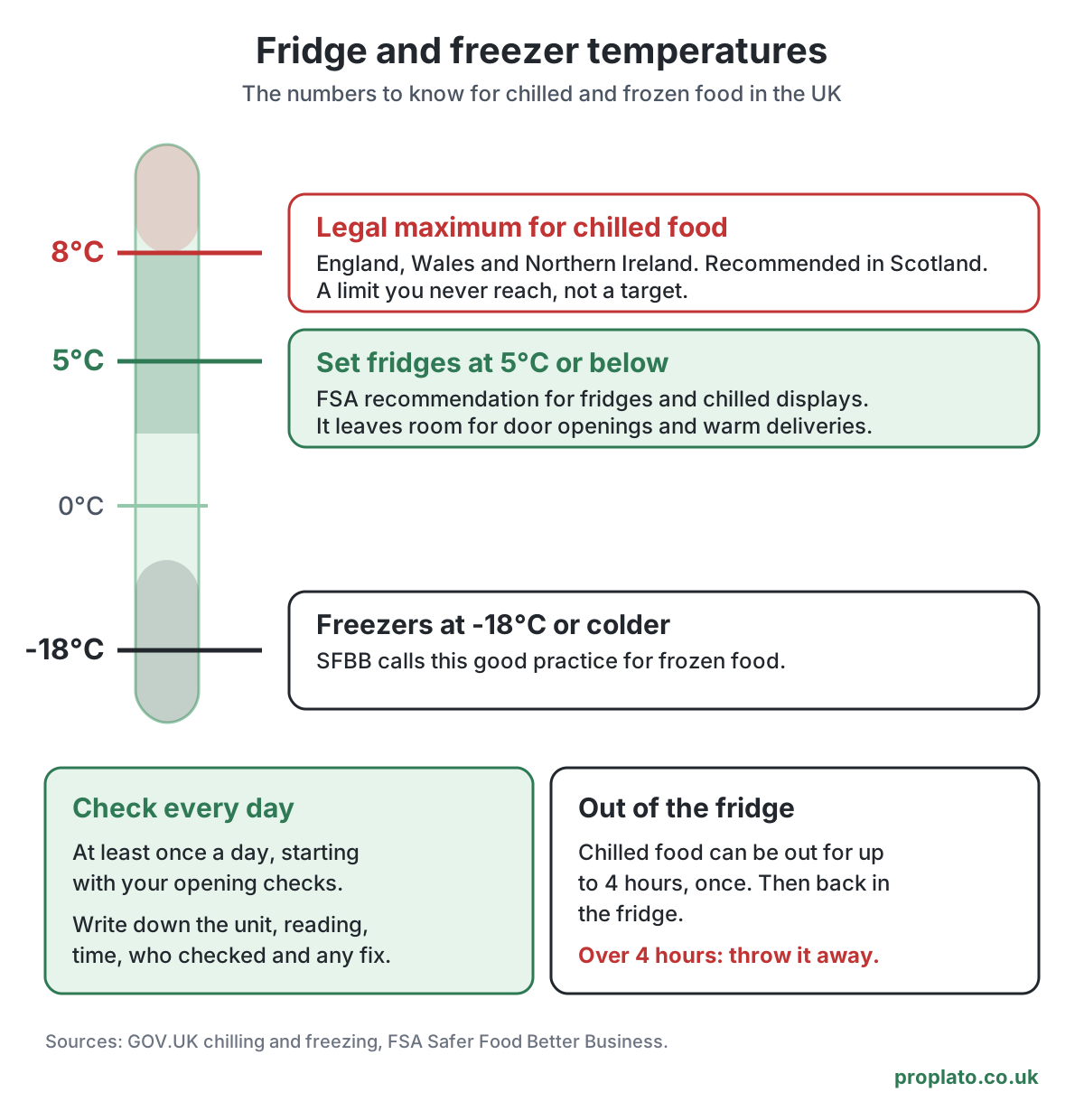
- Fridges and chilled display units: set them at 5°C or below. This is the Food Standards Agency (FSA) recommendation.
- Chilled food: must be kept at 8°C or below. This is a legal requirement in England, Wales and Northern Ireland, and recommended in Scotland. Treat 8°C as a limit you never reach, not a target.
- Freezers: keep frozen food at -18°C or colder. The FSA's Safer Food, Better Business (SFBB) pack calls this good practice.
- Food out of the fridge: chilled food can be kept out for up to 4 hours, once. If it has been out for less than 4 hours it can go back in the fridge. After that it must be thrown away.
Why 5°C and not 8°C
A fridge does not hold one steady temperature. Doors open, warm deliveries go in, and units cycle on and off. Setting the fridge at 5°C or below gives you room for those swings, so the food itself stays at 8°C or below. That is why the FSA recommends the lower setting.
How often to check
SFBB says to check the temperature of your fridges and chilled display equipment at least once a day, starting with your opening checks. A second check at closing helps you spot a unit that is struggling before you leave food in it overnight.
How to check:
- Read the unit's digital display or dial.
- Check now and then that the display is accurate, using a fridge thermometer or a clean, disinfected probe placed between packs of food.
- If a reading looks high, confirm it with a probe before you act on it.
What to write down
A useful temperature record answers five questions:
- Which unit? For example "Walk-in chiller" or "Prep fridge 2".
- What was the reading?
- When? Date and time.
- Who checked?
- What did you do? Only needed when a reading is out of range.
Under SFBB, you sign the diary each day and write down what went wrong and what you did about it. Logging every reading, not only the problems, gives you stronger evidence that the checks really happened, which matters if you ever need to show due diligence.
If a fridge reads above 5°C
- Check the food, not just the air. Probe between packs to see how warm the food actually is.
- Look for the cause. Is the door seal damaged, the unit overloaded, the door left open, or a warm delivery just loaded?
- Move the food if the unit is failing. SFBB says to use other equipment or move the food to a cold area.
- Ask for advice if you are unsure. If you cannot move the food, or you do not know how long the unit has been broken down, SFBB says to contact the Environmental Health team at your local council.
- Throw away food that has been unchilled for more than 4 hours.
- Write it down. Record the reading, what you did and who did it.
If you keep having problems with a unit, SFBB suggests checking whether the equipment is suitable for your business. Commercial equipment is generally better suited to catering than domestic fridges.
How long to keep temperature records
UK food hygiene law does not set one fixed period for keeping these records. The law asks for records that suit the nature and size of your business. The FSA's MyHACCP guidance asks you to decide how long to keep them, thinking about the shelf life of your products.
A practical approach: choose a period, write it into your food safety management system, and stick to it. Make sure it at least covers the longest shelf life of anything you store, including frozen stock.
Scotland
In Scotland, keeping chilled food at 8°C or below is recommended rather than set in law, and food businesses usually follow CookSafe from Food Standards Scotland instead of SFBB. The 5°C fridge setting and the habit of daily checks apply in the same way.
Paper or digital records?
Both are acceptable. What matters is that the checks happen and the records are easy to show. Paper diaries are cheap but easy to forget, lose or fill in after the fact. Digital logs add a timestamp to every entry. Read our comparison of digital and paper SFBB records for the pros and cons of each.
With Pro Plato, your team logs fridge and freezer checks on a phone. The Free plan covers basic temperature checks for one user. The Pro plan adds temperature issue alerts, timestamped photo evidence and a print-ready audit export. Checks save even with no signal and sync later.
Frequently asked questions
What temperature should a commercial fridge be in the UK?
Set it at 5°C or below. The legal maximum for chilled food in England, Wales and Northern Ireland is 8°C, so 5°C gives you a safety margin.
Is 8°C OK for a fridge?
8°C is the legal maximum for the food, not a setting to aim for. If your fridge is reading 8°C, act now: check the food, find the cause and record what you did.
What temperature should a commercial freezer be?
-18°C or colder. SFBB describes this as good practice.
Do I have to write down every reading?
SFBB asks you to sign the daily diary and record anything that went wrong and what you did about it. Logging every reading is not spelled out as a requirement, but it gives you a much stronger record if anything is ever questioned.
Sources
Checked 4 November 2026.
- GOV.UK: Food hygiene for businesses, chilling and freezing
- FSA: SFBB safe method, chilled storage and displaying chilled food (PDF)
- FSA: SFBB safe method, prove it, chilled and frozen storage (PDF)
- FSA MyHACCP: Principle 7, documentation and record keeping
- legislation.gov.uk: Regulation (EC) No 852/2004, Article 5
Note: this is general guidance for UK food businesses, not legal advice. Rules differ slightly across England, Wales, Scotland and Northern Ireland, so follow your local authority's advice. Last checked 4 November 2026.