Opening a Takeaway in the UK: The Food Safety Checklist
Opening a takeaway means a lot of paperwork before the first order goes out. Most of it comes down to a few legal duties: register, have a food safety system, train your staff, manage allergens and keep records. This guide walks through each one in order. It is written for new takeaways, delivery kitchens and food to go businesses in the UK.
1. Register with your local authority
GOV.UK says you must register with your local authority to run a food business. In England, Wales and Northern Ireland you are required to register at least 28 days before trading. You can apply online at register.food.gov.uk.
GOV.UK also recommends that you do not register too early. Wait until you are about 28 days from opening.
In Scotland, contact your local authority. Food Standards Scotland has advice for new businesses on its website.
2. Set up a food safety management system
The FSA says food businesses must use Hazard Analysis and Critical Control Point (HACCP) procedures, or a HACCP based food safety management system such as Safer Food, Better Business (SFBB).
You do not have to write one from scratch. There are free templates:
- England and Wales: Safer Food, Better Business (SFBB).
- Northern Ireland: Safe Catering.
- Scotland: CookSafe, from Food Standards Scotland.
For a typical takeaway, one of these packs is the simplest fit. Fill it in for your own menu, then keep the daily records it asks for. Our guide to food safety management systems explains each one and how to set it up.
3. Get your temperatures right
Takeaways cook, hold and chill a lot of food, so temperature checks matter from day one.
- Fridges: keep them at 5°C or below. In England, Wales and Northern Ireland, 8°C is the legal maximum for chilled food. It is a limit, never a target.
- Freezers: -18°C or colder.
- Cooking: get the centre of the food to 75°C or above, held for at least 30 seconds.
- Hot holding: once food is cooked, keep it at 63°C or above.
Probe the food and write the reading down. The guides on fridge and freezer temperatures and hot holding cover what to check and what to do when a reading is wrong.
4. Train your staff
GOV.UK says you must train all your staff and make sure they follow good personal hygiene.
Is a food hygiene certificate a legal requirement? No. The FSA says a certificate is not compulsory. It does recommend a food hygiene qualification if you are starting a food business. You will also need to show that you have been adequately trained in food hygiene.
The FSA also says staff must receive training on allergens. Keep a simple record of who has been trained and when.
5. Get allergens right
Allergens catch out a lot of new takeaways, because orders often come by phone or through an app.
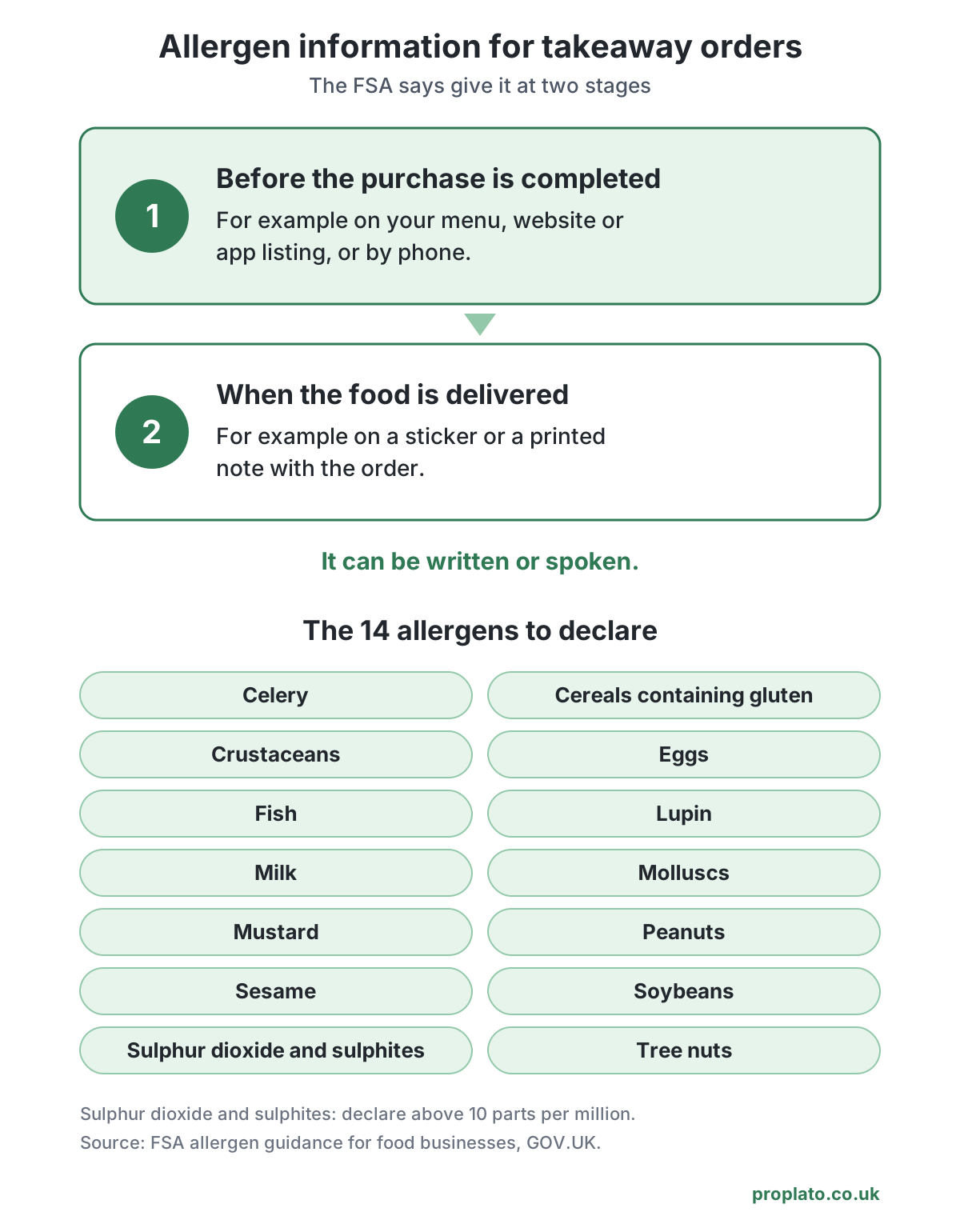
There are 14 allergens that must be declared: celery, cereals containing gluten, crustaceans, eggs, fish, lupin, milk, molluscs, mustard, peanuts, sesame, soybeans, sulphur dioxide and sulphites (above 10 parts per million), and tree nuts.
For takeaway and delivery orders, the FSA says allergen information must be provided at two stages:
- Before the purchase is completed, for example on your menu, website or app listing, or by phone.
- When the food is delivered, for example on a sticker or a printed note with the order.
It can be written or spoken.
If you make food and pack it before the customer orders, such as sandwiches or salads in a fridge, that is prepacked for direct sale (PPDS). The FSA says PPDS food needs a label with a full ingredients list, with the allergenic ingredients emphasised in it.
An allergen matrix helps your team answer allergen questions the same way every time.
6. Keep supplier records
GOV.UK says food businesses must keep records of their suppliers and of every business they supply. The FSA calls these traceability records. A simple list of each supplier, what they deliver and their contact details is a good start. Keep your invoices too.
7. Control other hazards
GOV.UK also says you must manage the risk of chemical and physical hazards to food. In a takeaway this means keeping cleaning chemicals away from food, and stopping things like glass, packaging or loose equipment parts from getting into it.
Our guide to cross-contamination covers keeping raw and ready to eat food apart, cleaning and cloths.
8. Check the licences you need
Food safety is not the only paperwork. In England and Wales, selling hot food or hot drink between 11pm and 5am is called late night refreshment. The Home Office lists it as a licensable activity under the Licensing Act 2003, and businesses that do it on a permanent basis must have a premises licence from their local authority. If you plan to open late, speak to your council's licensing team before you open.
The FSA also says that if you have five or more employees, you must have a written health and safety policy.
9. Get ready for your hygiene rating
When your council inspects you under the Food Hygiene Rating Scheme, the officer looks at three things:
- how hygienically the food is handled
- the physical condition of the business
- how the business manages ways of keeping food safe
In Wales and Northern Ireland you are legally required to display your rating. In England, display is voluntary but encouraged.
The third point is where records count. The officer will want to see your food safety system and the checks behind it. Our EHO visit checklist shows what to have ready.
Keeping the records on a phone
Daily checks are easier to keep up when they are quick. Pro Plato is one digital option. The Free plan covers opening and closing checklists and basic temperature checks on your phone. The Compliance Engine plan (£49 a month) adds a HACCP plan builder. Every plan, including Free, also includes an allergen matrix with a customer allergen QR code.
Frequently asked questions
How long before opening a takeaway do I need to register?
At least 28 days before you start trading, in England, Wales and Northern Ireland. GOV.UK recommends registering at about that point, not much earlier. In Scotland, contact your local authority.
Do I need a food hygiene certificate to open a takeaway?
No, the FSA says a certificate is not compulsory. You must still show you are adequately trained in food hygiene, and the FSA recommends a food hygiene qualification for anyone starting a food business.
Do takeaways have to give allergen information?
Yes. For takeaway and delivery orders, allergen information must be given before the purchase is completed and again when the food is delivered.
Do I need a licence to sell food late at night?
In England and Wales, selling hot food or hot drink between 11pm and 5am is late night refreshment, which is a licensable activity. Check with your council's licensing team.
What food safety system should a takeaway use?
Most takeaways use the free FSA pack for their nation: SFBB in England and Wales, Safe Catering in Northern Ireland, or CookSafe in Scotland.
Sources
Checked 7 November 2026.
- GOV.UK: Food business registration
- GOV.UK: Running a food business
- FSA: Starting a food business
- GOV.UK: Food safety management systems
- FSA: Allergen guidance for food businesses
- FSA: Food Hygiene Rating Scheme
- Home Office: Alcohol licensing (late night refreshment)
- GOV.UK: Chilling and freezing
- GOV.UK: Cooking food safely
- Food Standards Scotland: CookSafe
Note: this is general guidance for UK food businesses, not legal advice. Rules differ slightly across England, Wales, Scotland and Northern Ireland, so follow your local authority's advice. Last checked 8 November 2026.