
Hygiene Emergency Prohibition Notices: A Guide for UK Food Businesses
A hygiene emergency prohibition notice is one of the most serious steps a council food officer can take. It can stop a process, a piece of equipment or a whole kitchen from being used, without waiting for a court case first.
This guide explains, in plain English, when a notice can be served, what happens in the days after, how to get it lifted and how it differs from other food hygiene notices. It is based on the Food Safety and Hygiene (England) Regulations 2013, with the differences for Scotland, Wales and Northern Ireland at the end.
What is a hygiene emergency prohibition notice?
It is a written notice served on a food business operator by an authorised officer of the local authority. It bans the use of whatever is causing the risk. People often shorten it to HEPN.
The notice is the first step. The council must then ask a court to confirm the ban with a hygiene emergency prohibition order. That order is often called a HEPO.
When can an officer serve one?
The officer must be satisfied that the "health risk condition" is met, and for an emergency notice that means an imminent risk of injury to health. The regulations say the risk can come from:
- any process or treatment used in the business
- the construction of the premises, or the use of any premises or equipment
- the state or condition of any premises or equipment
Injury to health includes any impairment, whether permanent or temporary.
What the notice can stop
The ban depends on where the risk comes from. A notice can prohibit:
- a process or treatment
- the use of the premises or equipment for your business, or for any food business of the same type
- the use of the premises or equipment for any food business at all
The officer must put a copy of the notice in a conspicuous position on the premises as soon as practicable. Anyone who knowingly breaks the notice commits an offence.
What happens next: the court
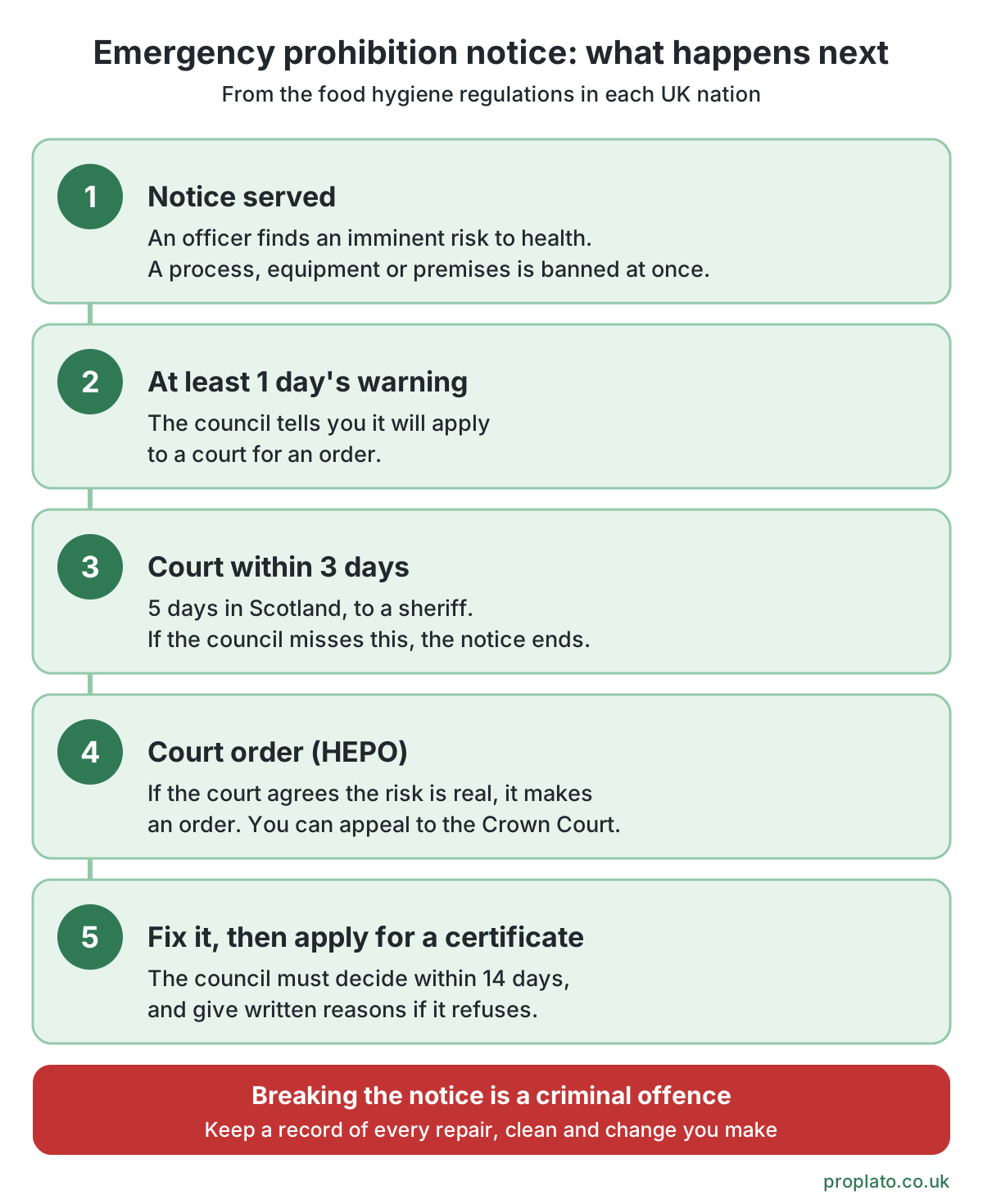
The council has a short deadline to take the case to court:
- It must give you at least one day's notice that it intends to apply for an order.
- It must apply to a magistrates' court within three days, starting with the day the notice was served.
- If it does not apply in time, the notice stops having effect at the end of that period.
If the court is satisfied that the health risk condition is met, it must make a hygiene emergency prohibition order. You can appeal an order to the Crown Court.
Getting the notice lifted
A notice or order ends when the council issues a certificate saying it is satisfied you have taken enough action to remove the risk.
- You can apply for the certificate. The council must decide as soon as reasonably practicable, and in any case within 14 days of your application.
- Once it is satisfied, it must issue the certificate within three days.
- If it refuses, it must give you written reasons.
- You can appeal a refusal to the magistrates' court.
Keep a written record of every repair, clean and change you make. It is the evidence the officer will look for before signing a certificate.
Compensation
The council must compensate you for losses caused by complying with the notice, unless both of these happen:
- it applied to the court within the three days, and
- the court declared itself satisfied that the health risk condition was met when the notice was served.
If you and the council cannot agree on the amount, the regulations send the dispute to arbitration.
Penalties
Breaking a hygiene emergency prohibition notice or order is a criminal offence. On summary conviction in a magistrates' court the penalty is a fine up to the statutory maximum. On conviction in the Crown Court it can be up to two years in prison, a fine, or both.
How it compares with other notices
| Notice or order | Who makes it | What it does | |---|---|---| | Hygiene improvement notice | Authorised officer | Lists what is wrong and what to do, with at least 14 days to put it right | | Remedial action notice | Authorised officer | Only for establishments that need approval; can stop equipment or a process, or slow production | | Hygiene emergency prohibition notice | Authorised officer | Bans a process, equipment or premises straight away where there is an imminent risk | | Hygiene prohibition order | Court, after a conviction | Bans a process, equipment or premises; can also ban a person from managing a food business |
You can appeal an improvement notice to the magistrates' court within one month, or within the period given in the notice if that is shorter.
Scotland, Wales and Northern Ireland
Each nation has its own regulations with the same structure:
- Scotland: the Food Hygiene (Scotland) Regulations 2006. The council applies to a sheriff, not a magistrates' court, and has 5 days to do so.
- Wales: the Food Hygiene (Wales) Regulations 2006. The three day rule is the same as in England.
- Northern Ireland: the Food Hygiene Regulations (Northern Ireland) 2006. The application must be made within 3 days of the notice being served.
Staying out of trouble
Most of what an officer checks is covered by the legal duties every food business already has. Our guide to food safety compliance sets them out in one list, and the EHO visit checklist shows what an inspection looks at.
Keeping your records ready
Pro Plato's Compliance Engine plan includes a print-ready inspection pack, a HACCP plan builder and timestamped photo uploads, so you can show an officer what you checked and what you fixed.
Frequently asked questions
Can an officer close my kitchen without going to court?
Yes, for a short time. An authorised officer can serve a hygiene emergency prohibition notice straight away. The council must then apply to a court within three days (five in Scotland) or the notice ends.
How long does a hygiene emergency prohibition notice last?
It lasts until the council issues a certificate saying the risk has been dealt with, or until it lapses because the council did not apply to court in time.
How do I get the ban lifted?
Fix the problem, keep evidence of what you did and apply to the council for a certificate. It must decide within 14 days of your application and give reasons if it refuses.
Can I get compensation?
Yes, unless the council applied to court in time and the court was satisfied the risk existed when the notice was served.
Sources
Checked 13 November 2026. This guide is general information, not legal advice.
- The Food Safety and Hygiene (England) Regulations 2013, regulation 8
- Regulation 6: hygiene improvement notices
- Regulation 7: hygiene prohibition orders
- Regulation 9: remedial action notices
- Regulation 19: offences and penalties
- Regulations 22 and 23: appeals
- The Food Hygiene (Scotland) Regulations 2006, regulation 8
- The Food Hygiene (Wales) Regulations 2006, regulation 8
- The Food Hygiene Regulations (Northern Ireland) 2006, regulation 8
- FSA: Food and feed codes of practice
Note: this is general guidance for UK food businesses, not legal advice. Rules differ slightly across England, Wales, Scotland and Northern Ireland, so follow your local authority's advice. Last checked 14 November 2026.