Food Safety Compliance for UK Food Businesses
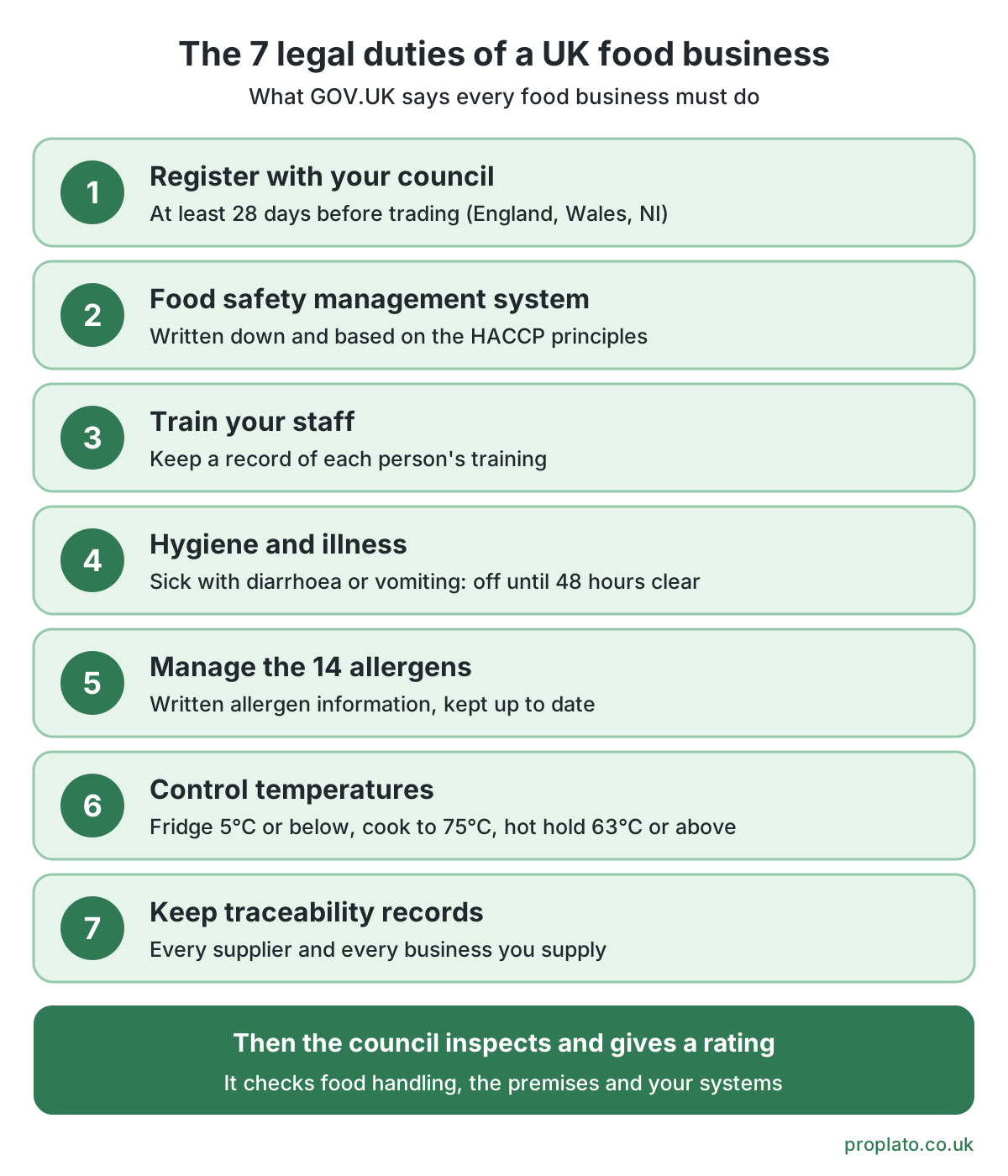
Food safety compliance means meeting the legal duties that come with selling, cooking, storing or handling food. The rules can look long, but most of them come down to a short list. GOV.UK sets out what every food business must do, from registering with the council to keeping records of your suppliers.
This guide walks through each duty in plain English and links to our more detailed guides. It is written for cafés, takeaways, restaurants, caterers and street food traders.
Who counts as a food business
GOV.UK says a food business is any business that sells, cooks, stores, handles, prepares or distributes food. That includes businesses trading from home, a van, a stall or temporary premises, and businesses that only sell online.
If any of that describes you, the duties below apply to you.
1. Register with your local authority
You must register with your local authority to run a food business. Registration is how the council knows you exist and when to inspect you.
- When: in England, Wales and Northern Ireland, register at least 28 days before you start trading. GOV.UK advises against registering much earlier than that.
- Where: if you trade from more than one site, register each site with the council where it is.
- Scotland: Food Standards Scotland has its own start up advice, or you can ask your local authority.
Our guide to opening a takeaway covers registration alongside the other first steps.
2. Have a food safety management system
GOV.UK says a food safety management system is a written set of processes, checks, rules and records. It usually covers cleaning and hygiene, safe cooking and storage, allergen controls, staff training and temperature checks.
Your system must meet the HACCP principles. In short, you need to:
- identify the hazards to avoid, remove or reduce
- find the critical control points where you deal with them
- set limits, monitor them and put things right when there is a problem
- check that the system works
- keep records
Most small caterers use a free pack such as Safer Food, Better Business (SFBB). Our guide to food safety management systems explains the options.
3. Train your staff
GOV.UK says you must be able to show that your staff have the right skills and up to date training for their role. Keep a record of the training each person has done, so you can show it at an inspection.
Training does not have to be a formal course. It can be on the job, self study or relevant past experience. Food handlers do not have to hold a food hygiene certificate. Staff must also be trained to manage allergies.
4. Keep good personal hygiene and manage illness
Staff must wear suitable, clean protective clothing. GOV.UK lists times when anyone working with food must wash their hands, including before preparing food, after touching raw food, after handling waste and after going to the toilet.
Staff must tell their manager if they feel unwell. Anyone with diarrhoea or vomiting must not handle food, and must not come back to work until they have had no symptoms for 48 hours.
5. Manage allergens
Giving accurate allergen information is a legal requirement. You must manage 14 allergens: celery, cereals containing gluten, crustaceans, eggs, fish, lupin, milk, molluscs, mustard, nuts, peanuts, sesame seeds, soya beans, and sulphur dioxide or sulphites above 10mg per kilogram or per litre.
GOV.UK says you should keep written allergen information and update it whenever a recipe or ingredient changes. You must also prevent allergen cross-contamination. If you package food on site to sell, the label must show the name of the food, an ingredients list and allergen information.
An allergen matrix is a simple way to keep this information in one place.
6. Control temperatures and cross-contamination
Temperature control is where many day to day checks happen. GOV.UK guidance says:
- Fridges: set them to 5°C or below. Chilled food must be kept at 8°C or below by law in England, Wales and Northern Ireland. Treat 8°C as the limit, never the target.
- Cooking: get the core of the food to 75°C or above, held for at least 30 seconds.
- Hot holding: keep hot food at 63°C or above until you serve it (above 63°C in Scotland).
Keep raw and ready to eat food apart, and clean and disinfect anything that has touched raw food. Our guides to fridge temperatures, hot holding and cross-contamination go into each one.
7. Keep traceability records
GOV.UK says you must keep records of your suppliers and every business you supply. These records must include:
- the name and address of every supplier
- the name and address of every business you supply
- the type and quantity of products
- the dates of each transaction and delivery
These records let unsafe food be withdrawn or recalled quickly. Keep them up to date and ready for inspection at all times. If food is unsafe, you must withdraw or recall it and report the incident.
Inspections and hygiene ratings
Your local council inspects food businesses to check they comply with food law. Usually you will not be told an inspection is coming. How often you are inspected depends on the risk your business poses.
The inspector looks at three things: how hygienically food is handled, the condition of the premises, and the systems and training you use to keep standards up. You will be told your rating in writing, either on the day or within 14 days.
| Nation | Scheme | Ratings | Displaying the sticker | |---|---|---|---| | England | Food Hygiene Rating Scheme | 0 to 5 | Voluntary | | Wales | Food Hygiene Rating Scheme | 0 to 5 | Mandatory | | Northern Ireland | Food Hygiene Rating Scheme | 0 to 5 | Mandatory | | Scotland | Food Hygiene Information Scheme | Pass or Improvement Required | Voluntary, but every rating is shown online |
On the 0 to 5 scale, 5 means hygiene standards are very good and 0 means urgent improvement is necessary. For serious problems, the council can serve a notice, such as a Hygiene Improvement Notice or a Hygiene Emergency Prohibition Notice. If you think your rating is wrong, you can publish a response, appeal or ask for a re-rating inspection.
Our EHO visit checklist shows what to have ready on the day.
Keeping the records on track
Most of compliance is doing the same checks every day and being able to prove it. Pro Plato is one digital option. The Free plan covers opening and closing checklists and basic temperature checks on your phone. The Compliance Engine plan (£49 a month) adds a HACCP plan builder, a COSHH register and risk assessments. Every plan, including Free, also includes an allergen matrix with a customer allergen QR code.
Frequently asked questions
What are the main food safety laws in the UK?
GOV.UK sums up the duties: make sure food is safe, register, train staff, have a food safety management system based on HACCP, manage allergens, label food accurately, keep traceability records and withdraw unsafe food.
Do my staff need a food hygiene certificate?
No. GOV.UK says food handlers do not have to hold one. You must be able to show they have the right skills and training for their role, so keep a training record.
How long before opening do I need to register?
At least 28 days before you start trading, in England, Wales and Northern Ireland. In Scotland, ask your local authority.
Do I have to display my food hygiene rating?
In Wales and Northern Ireland, yes. In England it is voluntary. In Scotland, ratings are shown on the Food Standards Scotland website whether or not you display them.
Does food safety compliance mean a top hygiene rating?
Not by itself. To get a 5, you must do well in all three areas the inspector checks: food handling, the premises and your management systems.
Sources
Checked 10 November 2026.
- GOV.UK: Running a food business (printable guide)
- GOV.UK: Food business registration
- GOV.UK: Food safety management systems
- GOV.UK: Food labelling, allergen information
- GOV.UK: Food hygiene for your business, chilling and freezing
- GOV.UK: Food hygiene for your business, cooking
- FSA: Food Hygiene Rating Scheme
- Food Standards Scotland: Food Hygiene Information Scheme
Note: this is general guidance for UK food businesses, not legal advice. Rules differ slightly across England, Wales, Scotland and Northern Ireland, so follow your local authority's advice. Last checked 11 November 2026.