The 4 Cs of Food Safety: A Guide for UK Food Businesses
The 4 Cs of food safety are cleaning, cooking, chilling and cross-contamination. Food hygiene courses use the phrase as a quick way to remember the basics. The Food Standards Agency (FSA) covers the same ground. Its guidance tells food businesses to follow "four main areas": cleaning, cooking, chilling and avoiding cross-contamination.
This guide explains each C in plain English, with the checks that matter in a UK kitchen. It is written for cafés, takeaways, restaurants, caterers and street food traders.
Where the 4 Cs come from
The 4 Cs are not a law in their own right. They are a memory aid for the controls that food hygiene law expects. You will see them in training, and the FSA's Safer Food, Better Business (SFBB) pack follows the same pattern. Its safe methods are grouped into cooking, chilling and cleaning, with separate sheets on separating foods, cloths and physical and chemical contamination. A management section covers opening and closing checks, training, suppliers and records.
If you use SFBB, you are already working through the 4 Cs. Our guide to food safety management systems explains SFBB and the other free packs.
1. Cleaning
Cleaning removes dirt, grease and germs from surfaces and equipment. It works best as a routine, not a reaction.
GOV.UK says you should set up a cleaning schedule and record. The schedule must cover:
- what needs to be cleaned or disinfected
- how often
- which products to use
For disinfectants and sanitisers, GOV.UK says to check the label includes BS EN 1276 or BS EN 13697. Always clean and disinfect food areas and equipment after they have touched raw food.
SFBB describes cleaning in two stages. First clean off visible dirt with hot soapy water or a cleaning product. Then apply disinfectant and leave it for the contact time on the label. Disinfectant only works on a surface that is already clean.
Cloths matter too. SFBB calls them one of the top causes of cross-contamination. Use disposable cloths where you can, and wash reusable ones on a hot machine cycle.
2. Cooking
Proper cooking kills harmful bacteria. The check is the temperature in the centre of the food, not how it looks.
- Cooking: get the core of the food to 75°C or above, held for at least 30 seconds. This is one of the time and temperature combinations GOV.UK lists. Use a clean probe thermometer and write the reading down.
- Steaming hot: GOV.UK also says to check food is steaming hot all the way through. Use this alongside the probe check, not instead of it.
- Reheating: GOV.UK says reheat food until it is steaming hot all the way through, and only reheat it once.
- Hot holding: GOV.UK says hot food must be kept at or above 63°C if you are not serving it straight away. In Scotland, keep it above 63°C.
GOV.UK allows hot food to be below 63°C for up to 2 hours. After that, cool it as quickly as possible to 8°C or below, or throw it away. Our guide to hot holding temperature covers this rule in full.
3. Chilling
Cold temperatures slow the growth of bacteria. Chilling covers fridges, chilled display, cooling hot food and defrosting.
- Fridges: GOV.UK says to set your fridge to 5°C or below, so food stays cold enough even if the temperature changes.
- The legal limit: chilled food must be kept at 8°C or below. This is a legal requirement in England, Wales and Northern Ireland, and recommended in Scotland. Treat 8°C as a limit, never a target.
- Cooling hot food: cool it as quickly as possible to 8°C or below.
- Defrosting: GOV.UK says to put frozen food in the fridge to defrost it safely. Bacteria can grow if defrosting food sits between 8°C and 63°C.
Check fridges at least once a day and record the reading. Our guide to fridge and freezer temperatures explains what to log and what to do when a reading is wrong, including freezer temperatures.
4. Cross-contamination
Cross-contamination is when bacteria spread between food, surfaces or equipment. The biggest risk is germs moving from raw food to ready to eat food.
The FSA's main controls are:
- Keep raw and ready to eat food apart. Separate areas, equipment and staff are best. If not, separate them by time, with thorough cleaning and disinfection in between.
- Store raw food below ready to eat food if they share a fridge, and keep everything covered.
- Separate equipment. Boards, knives and containers used for raw food should be disinfected by heat or a full dishwasher cycle before they are used for ready to eat food. If you cannot do that, use separate equipment. Colour coding makes this easy, though it is not a legal requirement.
- Wash hands between tasks, especially after handling raw food. The FSA says hand gels must not replace handwashing.
Allergens are part of this C too. Traces of an allergen can get into a dish through shared utensils, surfaces or oil. Our cross-contamination guide covers raw food, allergens and what to do if something goes wrong.
How the 4 Cs fit together
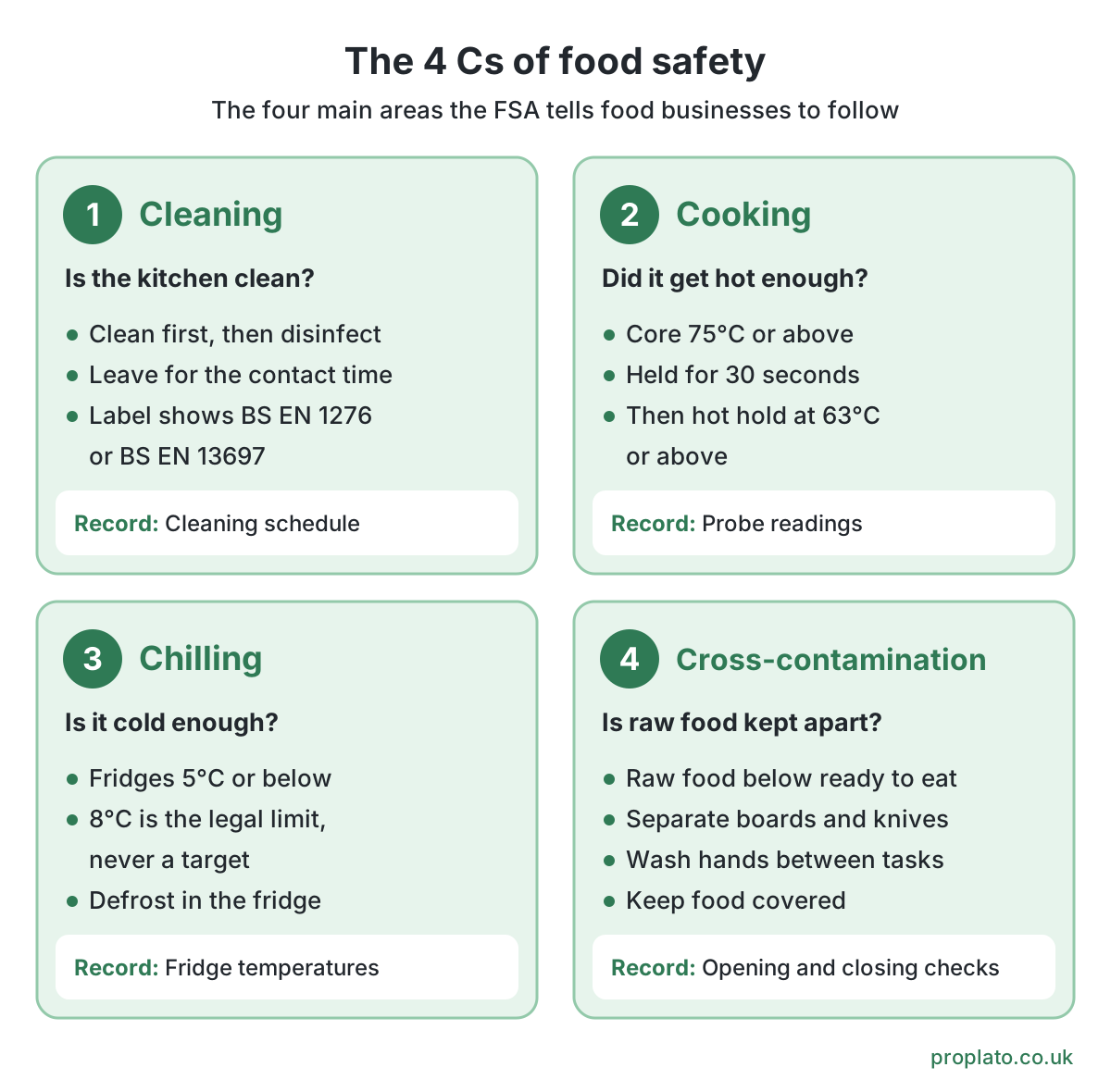
Each C covers a different moment in the life of a dish:
| C | Main question | Typical record | |---|---|---| | Cleaning | Is the kitchen clean and disinfected? | Cleaning schedule | | Cooking | Did the food get hot enough? | Probe readings | | Chilling | Is the food cold enough? | Fridge temperatures | | Cross-contamination | Is raw food kept away from ready to eat food? | Opening and closing checks |
The records are what an environmental health officer will ask to see. Our EHO visit checklist shows what to have ready.
Keeping the checks on track
Daily checks are easier to keep up when they take seconds. Pro Plato is one digital option. The Free plan covers opening and closing checklists and basic temperature checks on your phone. The Compliance Engine plan (£49 a month) adds a HACCP plan builder. Every plan, including Free, also includes an allergen matrix with a customer allergen QR code.
Frequently asked questions
What are the 4 Cs of food safety?
Cleaning, cooking, chilling and cross-contamination. The FSA lists the same four main areas for food businesses to follow.
Are the 4 Cs a legal requirement?
Not as a phrase. They sum up the controls that food hygiene law expects, such as keeping chilled food at 8°C or below and having a food safety management system based on HACCP.
Which of the 4 Cs is most important?
All four work together. A dish can be cooked properly and still be contaminated by a dirty board or kept too long out of the fridge.
Is personal hygiene one of the 4 Cs?
Not by name, but it runs through all of them. Handwashing is a key part of cleaning and of preventing cross-contamination.
How do the 4 Cs link to SFBB?
SFBB's safe methods are grouped into cooking, chilling and cleaning, with separate sheets on separating foods and contamination. Working through SFBB covers all four.
Sources
Checked 8 November 2026.
- FSA: Managing food hygiene (food banks and charities)
- FSA: Safer food, better business for caterers
- GOV.UK: Food hygiene for your business, cooking
- GOV.UK: Food hygiene for your business, chilling and freezing
- GOV.UK: Food hygiene for your business, cleaning
- GOV.UK: Food hygiene for your business, avoiding cross-contamination
- FSA: E. coli O157 control of cross-contamination guidance
- FSA: SFBB for caterers, separating foods (PDF)
- FSA: SFBB, cleaning effectively (PDF)
- FSA: SFBB for caterers, cloths (PDF)
Note: this is general guidance for UK food businesses, not legal advice. Rules differ slightly across England, Wales, Scotland and Northern Ireland, so follow your local authority's advice. Last checked 9 November 2026.