
Food Safety Temperatures for UK Food Businesses
Temperature control is one of the main ways a kitchen keeps food safe. Bacteria grow when food sits at the wrong temperature, so the law and the Food Standards Agency (FSA) set clear numbers for chilling, freezing, cooking, reheating and hot holding.
This guide puts every key number on one page, with what to check and what to record. It is written for cafés, restaurants, takeaways, pubs and caterers. Our detailed guides go further on each stage.
The key numbers at a glance
| Stage | The number | Where it comes from | |---|---|---| | Fridges | Set at 5°C or below | GOV.UK | | Chilled food | 8°C or below by law (England, Wales, NI) | GOV.UK and the 2013 regulations | | Freezers | -18°C or colder | FSA SFBB, good practice | | Cooking | Core 75°C for 30 seconds, or another safe time and temperature | GOV.UK | | Reheating | Steaming hot all the way through; at least 82°C in Scotland | GOV.UK and Scottish law | | Hot holding | 63°C or above; above 63°C in Scotland | The law in each nation | | Out of the fridge | Up to 4 hours, then throw it away | GOV.UK |
Chilling: fridges and chilled food
GOV.UK says to set your fridge to 5°C or below, so food stays cold enough even if the temperature changes. Chilled food must be kept at 8°C or below. That is a legal requirement in England, Wales and Northern Ireland, and recommended in Scotland.
Treat 8°C as the legal limit, never the target. A fridge set at 5°C gives you room when the door is opened often or a delivery goes in.
You can keep chilled food out of the fridge for up to 4 hours. After that, you must throw it away. If it has been out for less than 4 hours, it can go back in the fridge.
Our guide to fridge and freezer temperatures covers daily checks and what to do when a reading is too high.
Freezing and defrosting
The FSA's Safer Food, Better Business (SFBB) pack says keeping frozen food at -18°C or colder is good practice. GOV.UK says to cool cooked dishes before you put them in the freezer.
To defrost food safely, GOV.UK says put it in the fridge. Food must be fully defrosted before cooking, unless the manufacturer's instructions say to cook it from frozen. Bacteria can grow if defrosting food is kept between 8°C and 63°C.
Cooking
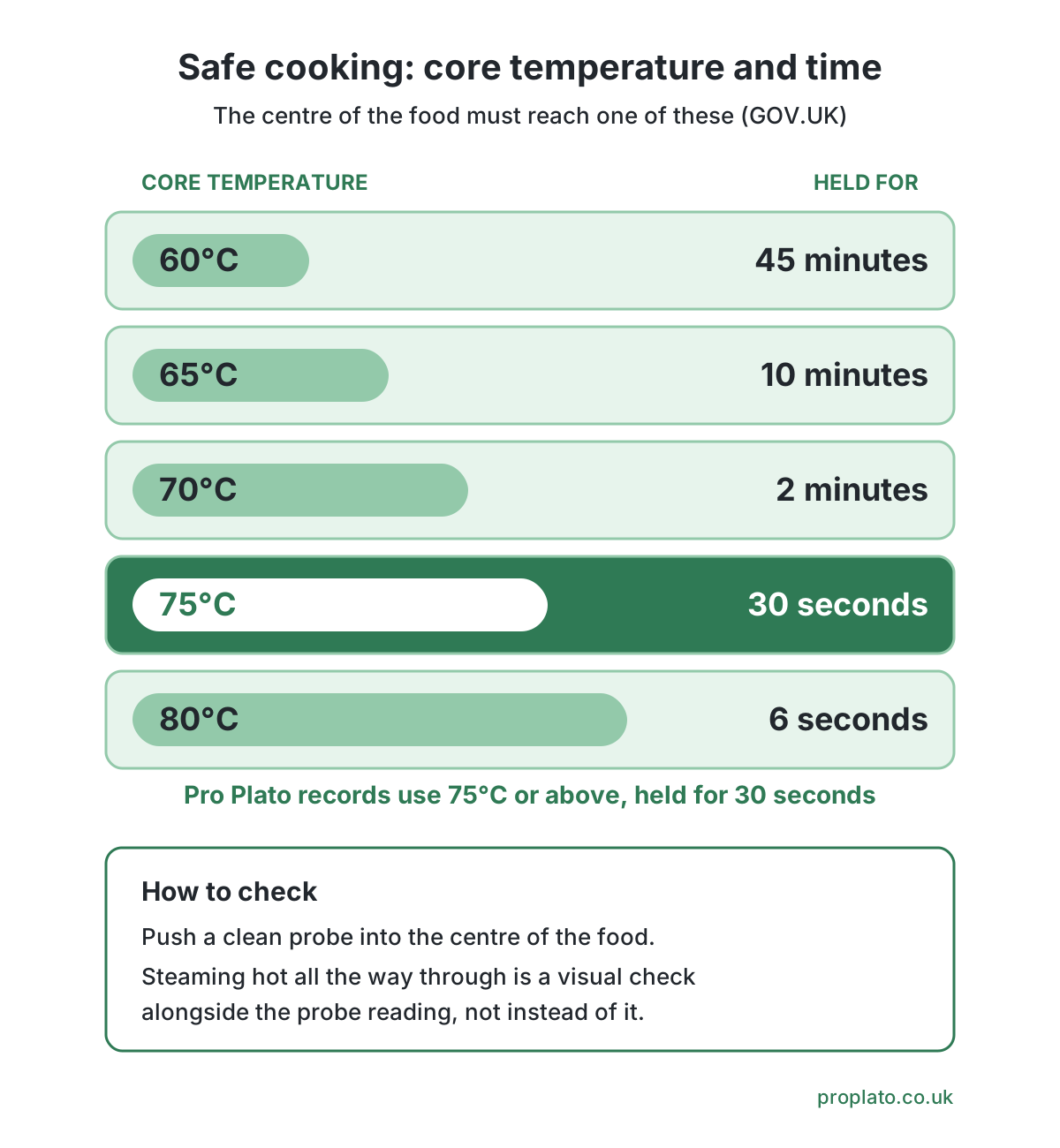
GOV.UK lists several time and temperature combinations that make food safe. The core of the food must reach one of these:
| Core temperature | Held for | |---|---| | 60°C | 45 minutes | | 65°C | 10 minutes | | 70°C | 2 minutes | | 75°C | 30 seconds | | 80°C | 6 seconds |
Check the core with a clean probe pushed into the centre of the food. GOV.UK also says to make sure food is steaming hot all the way through. Use that as a visual check alongside the probe reading, not instead of it. Pro Plato's records use 75°C or above, held for 30 seconds, as the cooking check.
Reheating
GOV.UK says to reheat food until it is steaming hot all the way through. You can only reheat food once.
In Scotland, the Food Hygiene (Scotland) Regulations 2006 say food that is reheated before serving must reach at least 82°C.
Do not reheat food in a bain-marie or hot cupboard. SFBB says hot holding equipment is for keeping food hot, not for heating it up.
Hot holding
Hot food you are not serving straight away must be kept at 63°C or above. That is the law in England. In Scotland, the law says food must be kept above 63°C.
Get the centre of the food to 75°C or above before it goes into hot holding, then keep it at 63°C or above.
GOV.UK says you can keep hot food below 63°C for up to 2 hours. After that, cool it as quickly as possible to 8°C or below, or throw it away. SFBB says you can only do this once.
Our guide to hot holding temperature has a flowchart for food that drops below 63°C.
Checking your probe thermometer
Every number above depends on a probe you can trust. SFBB lists a probe check among its extra checks: the probe should read within 1°C of 0°C in melting ice and within 1°C of 100°C in boiling water. Decide how often you do it and write it down.
Clean and disinfect the probe before and after each use, so it does not carry bacteria from raw food to cooked food.
What to record
A temperature you did not write down is hard to prove. SFBB calls these "prove it" checks. Keep a record of:
- fridge and freezer readings, at least once a day
- core temperatures of cooked and reheated food
- hot holding checks during service
- probe checks
- what you did when a reading was wrong
Our opening and closing checklist shows where these checks fit into the day.
Logging temperatures on a phone
Paper logs work, but they are easy to forget. Pro Plato is one digital option. The Free plan includes basic temperature checks on your phone. The Pro plan (£19 a month) adds temperature issue alerts, reminders and photo uploads with timestamps.
Frequently asked questions
What temperature should a commercial fridge be in the UK?
Set it to 5°C or below. Chilled food must be kept at 8°C or below by law in England, Wales and Northern Ireland, but 8°C is the limit, not the target.
What is the safe core temperature for cooked food?
GOV.UK lists 75°C for 30 seconds and other safe combinations, such as 70°C for 2 minutes. Check the core with a clean probe.
What temperature must hot food be kept at?
63°C or above in England. Above 63°C in Scotland. Food can be below 63°C for up to 2 hours, once, then you must cool it quickly or throw it away.
How hot should reheated food be?
GOV.UK says steaming hot all the way through, and only reheat once. In Scotland, reheated food must reach at least 82°C.
How long can chilled food be out of the fridge?
Up to 4 hours. Under 4 hours, it can go back in the fridge. After 4 hours, throw it away.
Sources
Checked 11 November 2026.
- GOV.UK: Food hygiene for your business, chilling and freezing
- GOV.UK: Food hygiene for your business, cooking
- legislation.gov.uk: Food Safety and Hygiene (England) Regulations 2013, Schedule 4
- legislation.gov.uk: Food Hygiene (Scotland) Regulations 2006, Schedule 4
- FSA: SFBB safe method, chilled storage and display (PDF)
- FSA: SFBB for caterers, hot holding safe method (PDF)
- FSA: SFBB for caterers, opening and closing checks (PDF)
- FSA: SFBB, prove it (PDF)
- Food Standards Scotland: CookSafe guide
Note: this is general guidance for UK food businesses, not legal advice. Rules differ slightly across England, Wales, Scotland and Northern Ireland, so follow your local authority's advice. Last checked 12 November 2026.