
Hot Holding Temperature: The 63°C Rule for UK Food Businesses
If you cook food and keep it hot before serving, the law sets a clear line: 63°C. This guide explains what the rule says, the one exception you can use, what to do when food drops below 63°C, and what to write down. It is written for cafés, takeaways, caterers and street food traders in the UK.
The rule at a glance
- Hot held food: keep it at 63°C or above until you serve it. In England this is the law. GOV.UK says hot food must be kept at or above 63°C if you are not serving it straight away.
- The 2-hour exception: you can keep hot food below 63°C for up to 2 hours, once. After that, reheat it or chill it, or throw it away.
- Scotland: the law says food must be kept above 63°C. Reheated food must reach at least 82°C.
- Before hot holding: get the centre of the food to 75°C or above first. Cooked food should reach 75°C for at least 30 seconds. Reheated food must be steaming hot all the way through (at least 82°C in Scotland). Then keep it at 63°C or above.
Why 63°C?
Harmful bacteria grow fastest at warm temperatures. Keeping cooked food hot stops them multiplying and producing toxins. The law in England makes it an offence to keep cooked or reheated food below 63°C when it is for service or on display for sale and needs to be kept hot to stay safe.
The 2-hour exception
Sometimes food needs to come out of hot holding, for example onto a buffet or a serving counter. The rules allow this, with limits.
GOV.UK says you can keep hot food below 63°C for up to 2 hours. After that, you must cool it as quickly as possible or throw it away. The FSA's Safer Food, Better Business (SFBB) pack adds that you can only do this once.
If the food has not been used within 2 hours, SFBB gives you two choices:
- Reheat it until it is steaming hot and put it back into hot holding.
- Chill it as quickly as possible. GOV.UK gives 8°C or below, which is the legal maximum for chilled food. Store it in a fridge set at 5°C or below.
If it has been out for more than 2 hours, throw it away. SFBB also warns not to mix new food with food that is already on display.
Using hot holding equipment properly
Bain-maries, hot cupboards and heated display units are for keeping food hot. They are not for cooking or reheating. SFBB says:
- Preheat the equipment before you put any food in it. Food put into cold equipment may not stay hot enough.
- Put food in hot. Food must be cooked thoroughly and be steaming hot before hot holding begins. Probe the centre first: 75°C or above is the check Pro Plato uses.
- Do not use it to reheat. Reheat on the hob, in the oven or in a microwave first, then transfer.
Smaller batches help. If food keeps dropping below 63°C, SFBB suggests trying a higher temperature setting or smaller quantities.
How to check hot held food
Use a clean, disinfected probe thermometer. Push it into the centre of the food, not just the surface. SFBB asks you to use a probe to prove your hot holding method keeps food at 63°C or above.
The SFBB hot holding method does not set a fixed number of checks. Decide how often you will check, based on how long food sits in hot holding and how busy you are. Write that into your food safety management system and stick to it. Checking at the start of service and at regular points during it is a common approach.
If food drops below 63°C
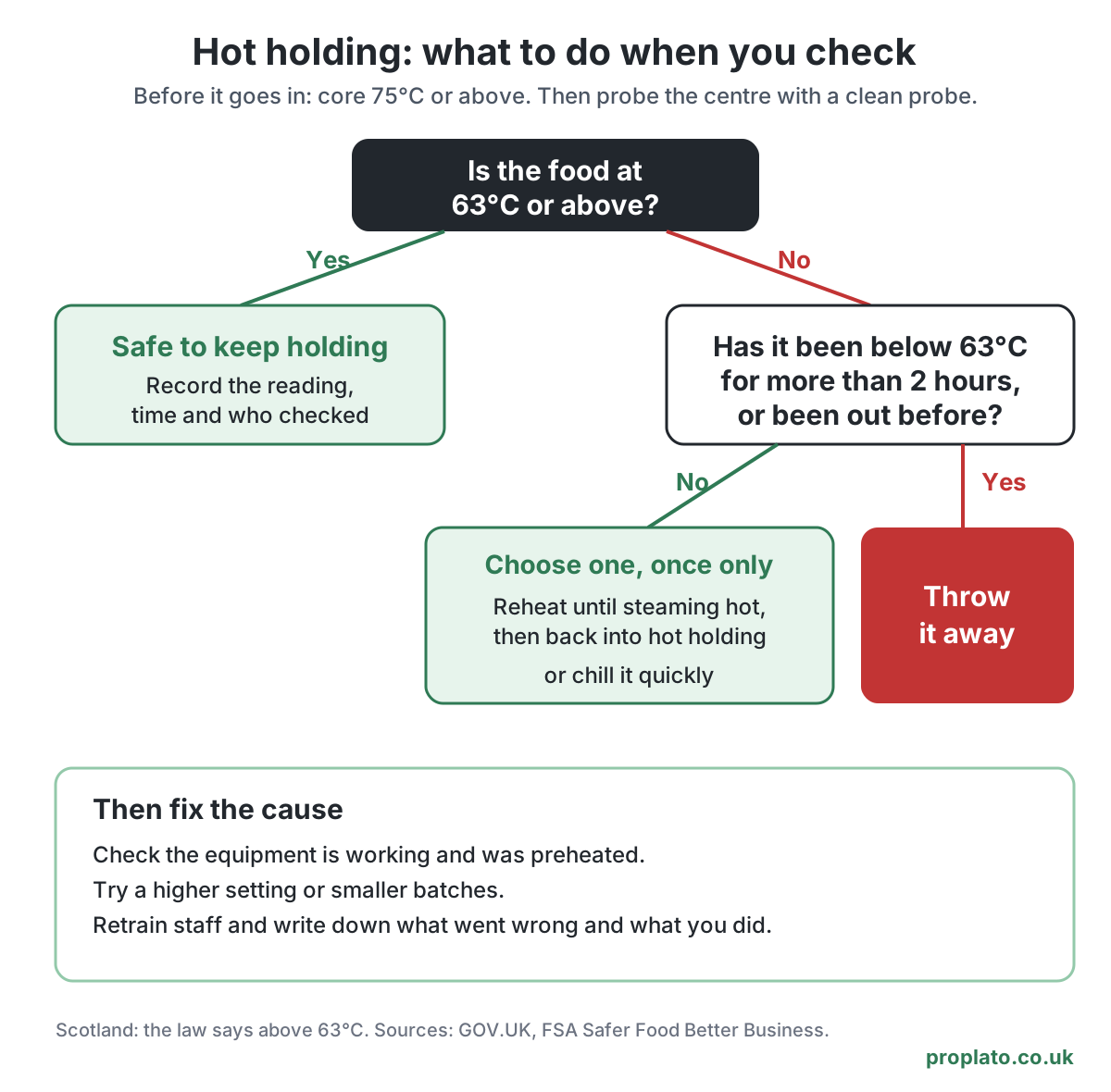
SFBB sets out what to do if a dish is not hot enough at any point during hot holding:
- Reheat it until it is a safe temperature and put it back into hot holding. Only do this once.
- Or chill it safely and reheat it later before serving.
- If you cannot do either, throw it away.
Then look for the cause. SFBB suggests you:
- check your equipment is working correctly
- review your hot holding method
- train staff again on the method
- improve staff supervision
What to write down
Under SFBB, you write down what went wrong and what you did about it in your diary. A useful hot holding record shows:
- What food and which unit, for example "Chicken curry, bain-marie 1"
- The probe reading
- The date and time
- Who checked
- What you did, if the reading was below 63°C
Logging every check, not only the problems, gives you better evidence that the checks really happened. That can help if you ever need to show due diligence. Our EHO visit checklist covers the other records an inspector may ask to see.
Scotland
Scotland has its own rules. The Food Hygiene (Scotland) Regulations 2006 say food must be kept above 63°C, not "at or above". Food that is reheated before serving must reach at least 82°C. Catering businesses in Scotland usually follow CookSafe from Food Standards Scotland, which helps them build HACCP-based procedures.
Keeping records on a phone
Paper logs work if you fill them in. Digital logs add the time to each entry automatically. With Pro Plato, the Free plan includes basic temperature checks for one user. The Pro plan (£19 a month) adds temperature issue alerts, photo uploads with timestamps and a one-click, print-ready audit export. For fridges and freezers, see our guide to fridge and freezer temperatures.
Frequently asked questions
What is the minimum hot holding temperature in the UK?
63°C. In England the law says 63°C or above, and the FSA's SFBB guidance uses the same figure. In Scotland the law says above 63°C.
Can hot food be kept below 63°C?
Yes, for up to 2 hours, and only once. After that, reheat it until steaming hot and put it back into hot holding, chill it quickly, or throw it away.
Can I reheat food in a bain-marie?
No. SFBB says hot holding equipment is for hot holding only. Reheat food first, then put it in preheated equipment.
How many times can I reheat hot held food?
Once. GOV.UK says you can only reheat food once. If it drops below 63°C again, throw it away.
What temperature should reheated food reach?
In Scotland, the law says at least 82°C. Elsewhere in the UK, GOV.UK says reheat food until it is steaming hot all the way through.
Sources
Checked 5 November 2026.
- GOV.UK: Food hygiene for your business, cooking
- FSA: SFBB for caterers, hot holding safe method (PDF)
- legislation.gov.uk: Food Safety and Hygiene (England) Regulations 2013, Schedule 4
- legislation.gov.uk: Food Hygiene (Scotland) Regulations 2006, Schedule 4
- Food Standards Scotland: CookSafe guide
Note: this is general guidance for UK food businesses, not legal advice. Rules differ slightly across England, Wales, Scotland and Northern Ireland, so follow your local authority's advice. Last checked 5 November 2026.