Cross-Contamination in Food Businesses: A UK Guide to Prevention
Cross-contamination is one of the most common causes of food poisoning. It is also one of the first things an environmental health officer looks at in a kitchen. This guide explains what cross-contamination is, the controls the Food Standards Agency (FSA) expects, and what to do if it happens. It is written for cafés, takeaways, restaurants and caterers in the UK.
What is cross-contamination?
GOV.UK describes cross-contamination as "when bacteria is spread between food, surfaces or equipment". The FSA's E. coli O157 guidance gives more detail. It is the transfer of harmful germs from raw meat or soiled vegetables to ready-to-eat food.
The FSA splits it into two types:
- Direct: raw food touches ready-to-eat food. Raw meat, unwashed fresh produce and frozen produce not marked as ready-to-eat are all sources.
- Indirect: germs travel on something in between. Surfaces, hands, equipment used for raw food and cloths are the usual routes.
E. coli O157 is the reason the rules are strict. The FSA says it can cause infection from fewer than 10 bacteria. The same controls also help against other bacteria such as campylobacter and salmonella.
Other kinds of contamination
Bacteria are not the only risk. The FSA's Safer Food, Better Business (SFBB) pack also covers:
- Physical contamination: objects such as glass, loose parts from equipment, or insects getting into food.
- Chemical contamination: cleaning products getting into food.
- Allergen cross-contamination: traces of one of the 14 allergens getting into a dish that should not contain it.
Keep raw and ready-to-eat food apart
The FSA says businesses must make sure that work areas, surfaces and equipment used for raw and ready-to-eat food are adequately separated. The most effective option is complete separation: separate staff, storage, preparation tables, utensils and equipment.
In order of effectiveness, the FSA lists:
- A separate room for ready-to-eat food.
- A permanent clean area used only for ready-to-eat food.
- Separation by time, using the same area at different times, with strict cleaning and disinfection in between.
SFBB adds a simple habit. Where possible, prepare ready-to-eat food before raw food. Do not wash raw meat or poultry, because it splashes bacteria around the kitchen.
Storing food safely
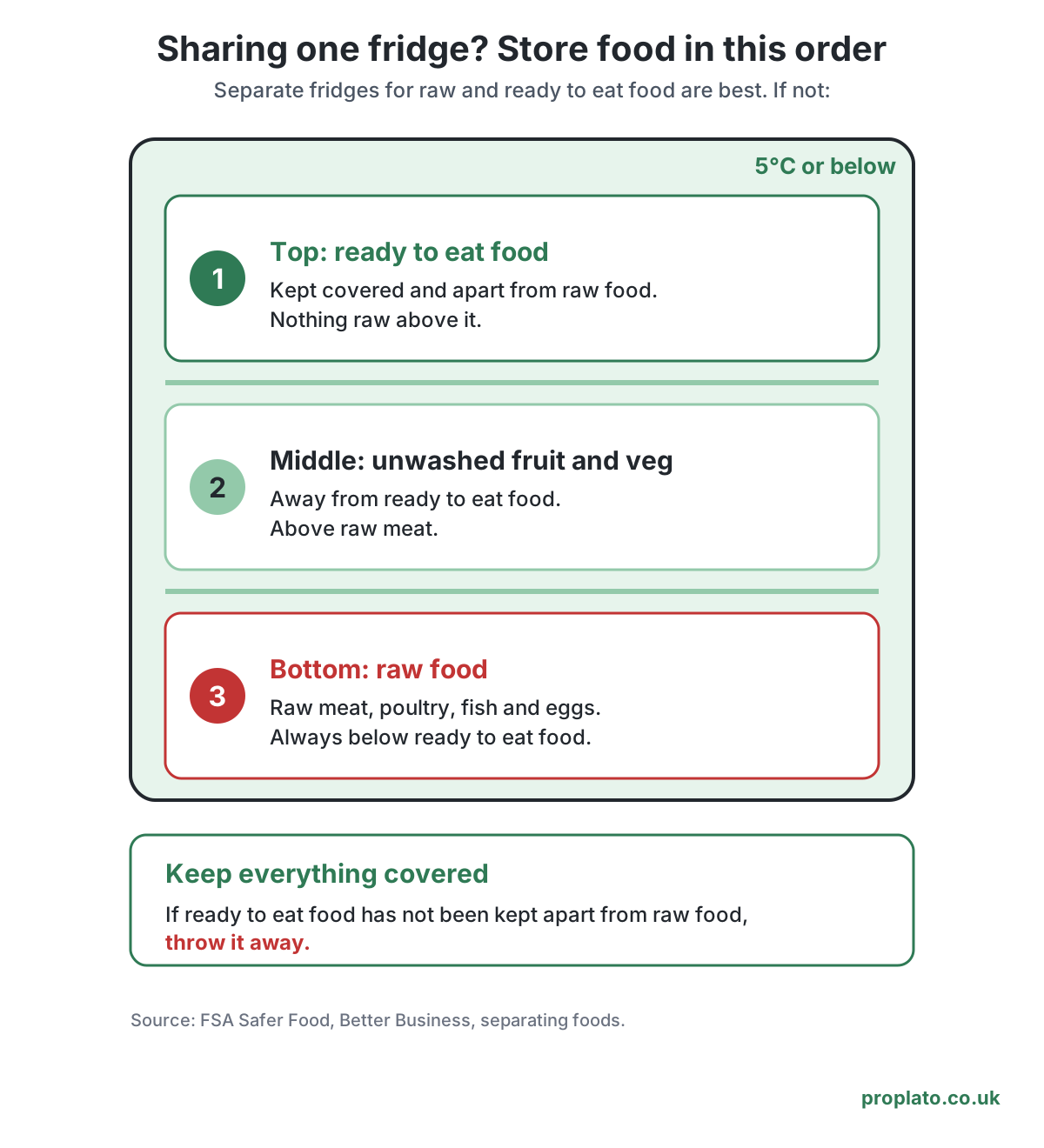
SFBB says to store raw and ready-to-eat food in separate fridges, freezers and display units if you can. If they share a unit:
- store raw meat, poultry, fish and eggs below ready-to-eat food
- keep unwashed fruit and vegetables away from ready-to-eat food and above raw meat
- keep food covered
Keep your fridges at 5°C or below. Our guide to fridge and freezer temperatures covers the checks and records.
Chopping boards and equipment
The legal point is separation. The FSA says boards, containers and tongs used for both raw and ready-to-eat food should be disinfected by heat or a full dishwasher cycle between uses. If you cannot do that, you must use separate equipment for raw food and for ready-to-eat food.
Are colour-coded boards a legal requirement? No. The FSA strongly recommends separate, easily identifiable equipment, such as colour-coded boards and knives. It becomes essential where you have no heat disinfection or dishwasher. Replace boards that have deep scores.
Complex equipment
Vacuum packers, slicers, mincers, blenders and mixers are hard to clean. The FSA says they must not be used for both raw and ready-to-eat food unless they are fully dismantled and disinfected between uses. For slicers and mincers, the FSA says this cannot be done effectively during a normal working day. In practice, keep separate machines.
Cleaning: two stages, every time
SFBB says cleaning and disinfection happen in two stages:
- Clean. Use hot, soapy water or a cleaning product to remove visible dirt, grease and debris.
- Disinfect. Apply a disinfectant all over the surface and leave it for the contact time on the label.
Disinfectants only work on surfaces that are already clean. GOV.UK says to check the label shows BS EN 1276 or BS EN 13697. Always clean and disinfect food areas and equipment after they touch raw food.
GOV.UK also says you must be able to prove you clean effectively. Keep a cleaning schedule that covers what to clean, how often and which products to use.
Cloths
SFBB calls cloths one of the top causes of cross-contamination. Use disposable cloths where possible and throw them away after each task. Wash reusable cloths on a hot machine cycle; SFBB gives 90°C as a suitable temperature. Bleach is not a suitable disinfectant for cloths.
Hands, gloves and clothing
- Wash hands thoroughly with soap and warm water between tasks, especially before and after handling raw food.
- Hand gels must not replace handwashing. The FSA says they can be used after handwashing as an extra step.
- Gloves are not a substitute for handwashing. Change them as often as you would wash your hands, and wash your hands when you change them.
- Aprons: SFBB says staff should change aprons after working with raw food.
- Illness: staff who have had diarrhoea or vomiting should not return to work until they have had no symptoms for 48 hours.
Allergen cross-contamination
The FSA's allergen guidance asks businesses to:
- clean utensils before each use, especially after preparing dishes with allergens
- wash hands thoroughly between dishes with and without certain allergens
- store ingredients in closed, labelled containers, with allergen ingredients kept separate
- not reuse oil that has cooked battered fish for gluten-free chips
If you cannot avoid cross-contamination, the FSA says you should tell the customer you cannot provide an allergen-free dish. An allergen matrix helps your team answer allergen questions accurately.
If cross-contamination happens
SFBB is clear:
- If ready-to-eat food has not been kept apart from raw food, throw it away.
- If raw food touched equipment, surfaces or utensils, wash, disinfect and dry them.
- If chemicals or objects such as glass get into food, throw the food away.
- If a dirty cloth was used, clean and disinfect what it touched and throw away food that might be contaminated.
Then write down what went wrong and what you did about it.
Keeping the checks on track
Cleaning schedules, allergen information and daily checks are easier to prove when they are recorded. Pro Plato is one digital option. The Free plan covers opening and closing checklists and basic temperature checks. The Compliance Engine plan (£49 a month) adds a HACCP plan builder and a COSHH register. Every plan, including Free, also includes an allergen matrix with a customer allergen QR code.
Frequently asked questions
What is the main cause of cross-contamination?
Germs moving from raw food to ready-to-eat food, either directly or on hands, surfaces, equipment and cloths.
Do I have to use colour-coded chopping boards?
No, it is not a legal requirement. You must keep raw and ready-to-eat equipment separate, or disinfect it by heat or a full dishwasher cycle between uses. The FSA strongly recommends colour coding to make separation easy.
Where should raw meat go in the fridge?
Below ready-to-eat food, or ideally in a separate fridge.
Can I use the same slicer for raw and cooked meat?
The FSA says no, unless it is fully dismantled and disinfected between uses, which it says cannot be done effectively during a working day. Use separate machines.
Is hand sanitiser enough?
No. The FSA says hand gels must not replace handwashing.
Sources
Checked 6 November 2026.
- FSA: E. coli O157 control of cross-contamination guidance
- GOV.UK: Food hygiene for your business, avoiding cross-contamination
- GOV.UK: Food hygiene for your business, cleaning
- FSA: SFBB for caterers, separating foods (PDF)
- FSA: SFBB, cleaning effectively (PDF)
- FSA: SFBB for caterers, cloths (PDF)
- FSA: SFBB for caterers, personal hygiene (PDF)
- FSA: SFBB, physical and chemical contamination (PDF)
- FSA: Allergen guidance for food businesses
Note: this is general guidance for UK food businesses, not legal advice. Rules differ slightly across England, Wales, Scotland and Northern Ireland, so follow your local authority's advice. Last checked 6 November 2026.