
How to Appeal a Food Hygiene Rating in the UK
Got a food hygiene rating you think is wrong? You have three options, and the appeal deadline is short. This guide explains how an appeal works, when a "right to reply" or a re-rating visit is the better choice, and what changes between England, Wales and Northern Ireland. Scotland runs a different scheme, covered near the end.
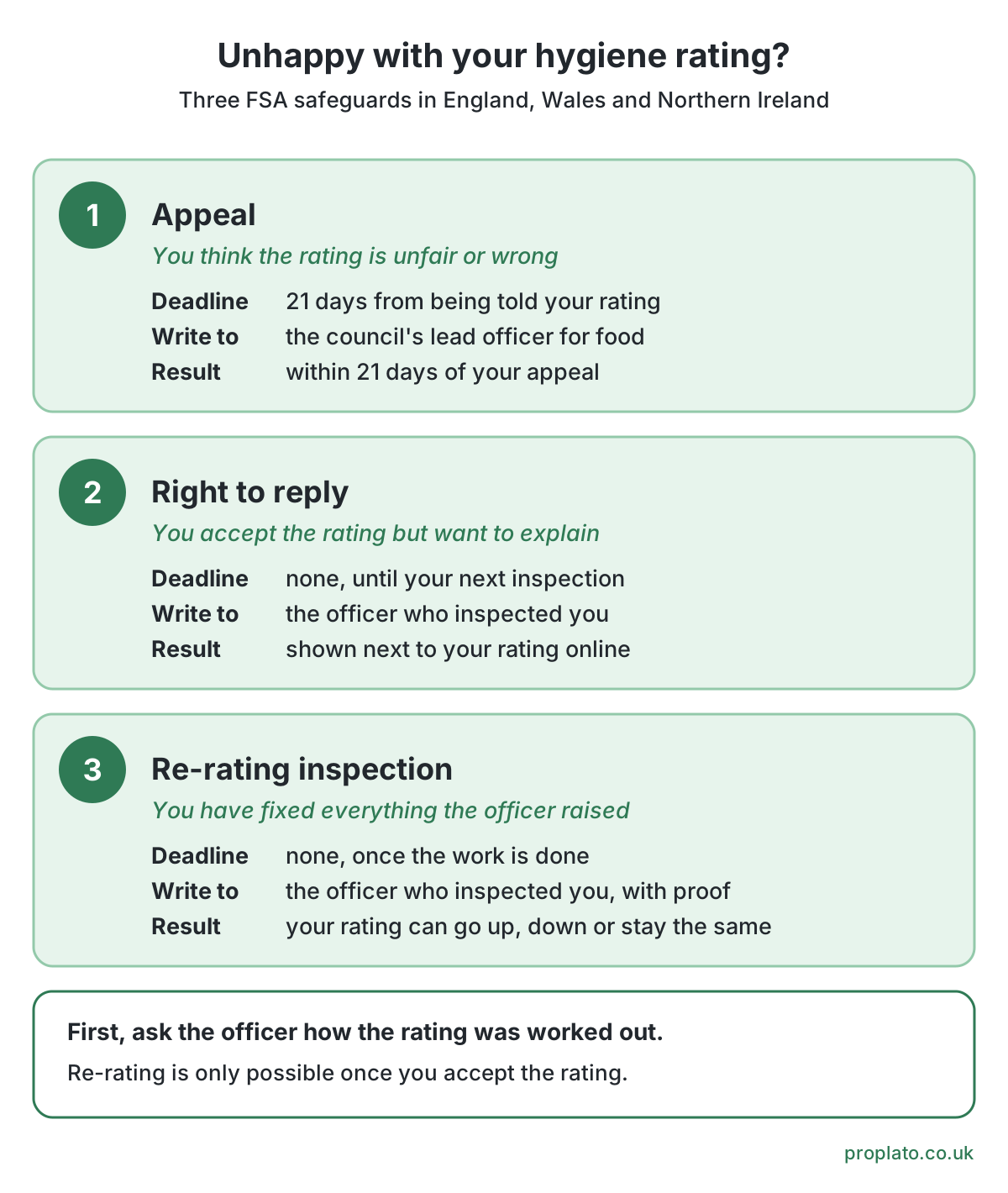
Your three options at a glance
The Food Standards Agency (FSA) gives every business three safeguards under the Food Hygiene Rating Scheme (FHRS):
| Option | Use it when | Deadline | Who you write to | |---|---|---|---| | Appeal | You think the rating is unfair or wrong | 21 days from being told your rating | The council's lead officer for food | | Right to reply | You accept the rating but want to explain or show improvements | None, any time before your next inspection | The officer who inspected you | | Re-rating inspection | You have fixed everything the officer raised | None, any time after the work is done | The officer who inspected you |
A re-rating request is only possible once you have accepted the rating, so decide first whether you are appealing.
How you find out your rating
After an inspection, the council tells you in writing what your rating is and why. This happens at the inspection or within 14 days of it, including weekends and public holidays.
The rating scale runs from 5 to 0:
- 5: hygiene standards are very good
- 4: good
- 3: generally satisfactory
- 2: some improvement is necessary
- 1: major improvement is necessary
- 0: urgent improvement is necessary
The officer looks at three things: how hygienically food is handled, the physical condition of the premises, and how you manage food safety (your processes, training and systems). A rating is a snapshot of what the officer saw on the day.
A 5 goes online as soon as the council uploads it. A rating of 0 to 4 is published 3 to 5 weeks after the inspection, so there is time for an appeal.
Step 1: talk to the officer first
Before you appeal, the FSA says you should contact the officer who inspected you and ask how the rating was worked out. Their contact details are in your rating letter.
This may answer your question. You may find the score came from one area you can fix quickly, in which case a re-rating visit may suit you better than an appeal.
Step 2: make the appeal in writing
If you still think the rating is unfair or wrong, appeal in writing to your council.
- England and Northern Ireland: use the FSA appeal form, or send a letter or an email.
- Wales: you must use the standard appeal form.
Send it to the council's lead officer for food. Their details are also in your rating letter.
The deadline is 21 days from the day you were told your rating. Weekends and public holidays count. If you miss it, the council publishes the rating.
What to put in your appeal
Keep it factual. Say which part of the rating you disagree with and why. Attach evidence that shows what the officer saw, or should have seen, on the day. Useful evidence includes:
- temperature records for the days around the inspection
- cleaning schedules and opening and closing checks
- staff training records
- your written food safety management system
- dated photos of the premises and equipment
An appeal is about whether the rating was right on the day. Work you did afterwards belongs in a right to reply or a re-rating request instead.
What happens after you appeal
While the appeal is open, the ratings website shows your business as "awaiting publication".
Your appeal is reviewed by the lead officer for food or their deputy, or by an officer from another council that runs the scheme. The officer who gave the rating does not decide your appeal. Sometimes another visit to your premises is needed.
The council must tell you the result within 21 days of receiving your appeal. The rating is then published.
If you disagree with the result
If you think the council did not follow the proper process, use its complaints procedure. After that you can go to the Local Government Ombudsman in England and Wales, or the Public Services Ombudsman in Northern Ireland. You can also challenge the decision by judicial review. Your rating is still published while you do this.
Right to reply
A right to reply lets you tell customers what you have improved, or explain unusual circumstances on the day of the inspection. The council publishes it next to your rating on the ratings website.
Send it in writing to the officer who inspected you, using the FSA form, a letter or an email. There is no deadline. The council may edit out anything offensive, defamatory, clearly inaccurate or irrelevant. Your comment stays online until you get a new rating.
Re-rating inspection
If you did not get a 5, you can ask for a re-rating inspection before your next planned one. You can only do this once you have accepted the rating and made all the improvements the officer asked for.
Send proof. You must explain what you have done and should include evidence such as receipts or photos. The council can refuse your request if the evidence is not good enough.
Be ready for the whole kitchen to be checked again. The officer looks at standards generally, so your rating could go up, go down or stay the same.
Fees and timings
- England: some councils charge a fee. If yours does not, you get one re-rating visit between planned inspections, and it will not usually happen in the first three months. If you ask in those three months, expect a visit within six months of the inspection. If you ask later, or your council charges, expect one within three months.
- Wales and Northern Ireland: every council charges a fee. Any appeal must be settled first, and you must be displaying your current sticker. The visit takes place within three months of your written request.
You are not told the date or time of the visit. Your new rating comes in writing at the visit or within 14 days.
Displaying your rating while you wait
In Wales and Northern Ireland you must, by law, display your rating at or near each customer entrance. In England, display is voluntary. In England and Wales you can also ask the council in writing to publish a rating early, before the appeal period ends.
Scotland
Scotland uses the Food Hygiene Information Scheme (FHIS) instead. Businesses get Pass or Improvement Required, not a number. For a question or complaint about your FHIS result, contact your local authority.
Stop it happening again
One of the three things the officer scores is how you manage food safety: your processes, training and systems. Our guides to food safety compliance and the EHO visit checklist list what an officer looks for.
Pro Plato's Pro plan keeps your temperature logs and checklists on your phone, with timestamped photo uploads and audit exports. That gives you dated records and photos to send with an appeal or a re-rating request.
Frequently asked questions
How long do I have to appeal a food hygiene rating?
21 days from the day you are told your rating, in England, Wales and Northern Ireland. Weekends and public holidays count.
Can my rating go down after an appeal or a re-rating visit?
At a re-rating visit, yes. The officer checks standards generally, so the rating can go up, down or stay the same. An appeal may also lead to another visit.
Does the officer who inspected me decide the appeal?
No. The lead officer for food, their deputy, or an officer from another council reviews it.
Is there a deadline for a right to reply?
No. You can send it at any time until your next inspection gives you a new rating.
Can I hide a low rating while I fix things?
No. If you do not appeal within 21 days, the rating is published. In Wales and Northern Ireland you must also display it at your entrance.
Sources
Checked 16 November 2026. This guide is general information, not legal advice.
- FSA: Food Hygiene Rating Scheme guidance for businesses
- FSA: Food Hygiene Rating Scheme safeguards for businesses
- GOV.UK: Food hygiene rating scheme guidance for businesses
- Food Standards Scotland: Food Hygiene Information Scheme
Note: this is general guidance for UK food businesses, not legal advice. Rules differ slightly across England, Wales, Scotland and Northern Ireland, so follow your local authority's advice. Last checked 17 November 2026.